

3 Modern Base Details

Modernism isn’t so much a style as it is a way of thinking -a philosophy if you will. The modern mindset guides nearly everything about how a home is designed and constructed, even down to the base trim details. As with modern design in general, modern base details are intentional and functional –they are everything they need to be and nothing more. Today’s post covers three of BUILD LLC’s favorite modern base details, complete with construction details. The good news is that many of the examples are hot off the press and just completed on a recent project, the bad news is that there’s a bit of dust to put up with -please pardon the mess.

For comparison purposes, here is a standard applied base detail (below), typically a 3-1/2” profile applied on top of the drywall. In more traditional applications there’s even a small piece of quarter round in the corner of the base trim and the floor – a base for the base.

Flush Base: the 3-1/2” or 5-1/2” tall base trim is recessed so that it’s flush with the wall. While it takes a bit more work and care to install, the look is clean and unencumbered. It’s a museum quality finish that can be achieved cost-effectively.

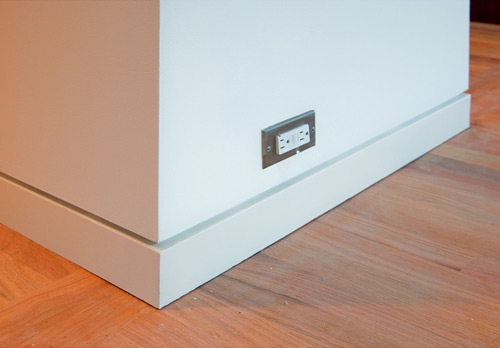
We’re big fans of how the horizontal reveal at the flush base meets the vertical reveals at doors and other breaks.

At the condition below the flush base profile actually turns and becomes a vertical bumper for a set of interior sliding doors.

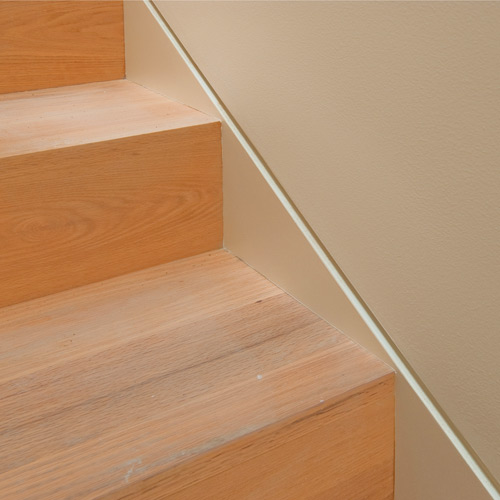
The flush base makes for a clean transition at areas like stairways (often a tricky situation for base trim).
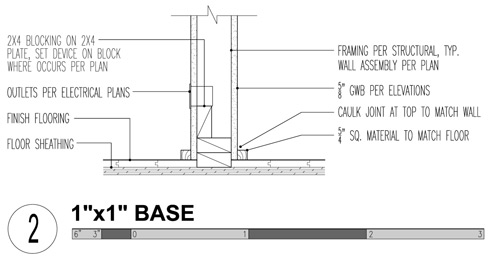
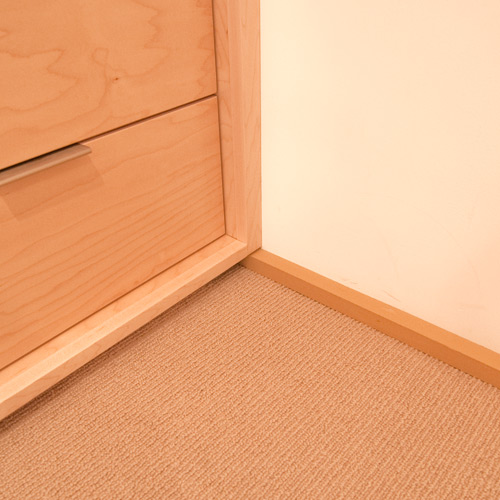
1×1 Base: the low profile section covers the gap between the drywall and the floor and also provides a bumper for shoes, vacuum cleaners, etc. At hardwood applications we tend to match the base with the hardwood (in this case maple), at carpet applications we’ll paint the base trim something close to the carpet. The end goal is to achieve a subtle profile that doesn’t draw your attention to the base.
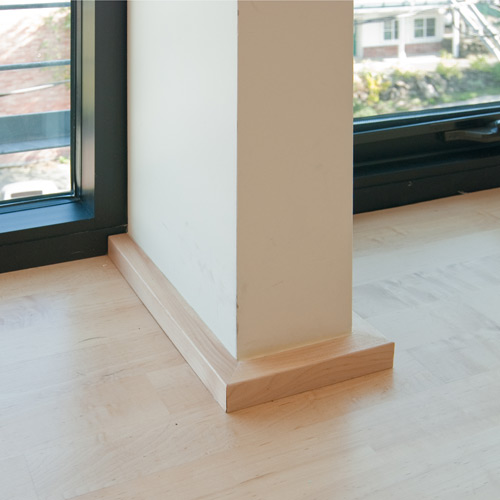
The low profile of the 1×1 base often works much better with window systems – a taller base trim would seem less deliberate and clunky compared to the sleek, minimal window frames.
We’ll often bring the toe-kick of cabinetry down to the level of the 1×1 base trim, the trim aligns with and disappears into the shadow line of the cabinets (you also get a few extra inches of storage out of the cabinets).
Similarly with sills, the level of the window sill is brought down a few inches to align with the base trim. It’s a clean modern look and maximizes the amount of daylight.

Baseless: The most minimal of the bunch is actually a baseless condition where a piece of Z-metal separates the drywall from the floor leaving a ¾” reveal –or shadow line as we like to call it. The application is only used in certain situations, typically industrial or commercial applications where there isn’t a lot of foot traffic. Used correctly, it can give that sparse Chelsea gallery look that puts focus on the things and people in the room rather than the room itself.

For us, modernism is all about losing the fussiness of design and allowing for more flexibility, durability and quality of life in and around architecture. Stay tuned for more modern design and technical details from BUILD LLC.

Get more of our research and development by following us on Twitter.

43 Comments

  • By Sean, October 18, 2010 @ 9:20 am

    Nice details. It should be pointed out that the Reveal without a base detail should not really be done with a t&g wood floor as shown in your drawn detail. In order to construct the detail properly you would be leaving no room for the wood to expand/contract, unless you left gaps between the flooring in several locations. With hardwood floor, better to pad out the sheetrock to get the same effect but still allowing the wood to move. Otherwise, very nice.

  • By Build LLC, October 18, 2010 @ 9:33 am

    @Sean – great point! Our detail should be modified to either show a different floor type or sometimes we’ll use a strip of cork between the hardwood and the bottom plate of the framing. Good catch.

  • By Nicholas Williams, October 18, 2010 @ 10:08 am

    Damn!…you guys share all your good details! thanks for posting…I especially like the 1×1 to cabinet toe kick detail…love that shadow line. But is it functional? you probably wouldn’t want this detail at say a kitchen sink…no where for your toes!

  • By Build LLC, October 18, 2010 @ 10:37 am

    @ Nick -glad you like. Indeed, the 1×1 isn’t a detail for the kitchen but works great at bedrooms, hallways, dens, etc.

  • By Garrett, October 18, 2010 @ 10:59 am

    Another, even more minimal is the tape-to-the-floor. Great with a concrete floor…David Baker has a nice image of this…http://www.dbarchitect.com/article_slideshow/87.html#456

  • By biglew, October 18, 2010 @ 1:38 pm

    Well done, another great post with details. I like it very much. I’ll try to incorporate some of the spirit of these designs in some of my next work. Pretty cool how a much overlooked aspect of finish work can take on interesting dimensions with such a few tweaks. Me likey

  • By William B., October 18, 2010 @ 1:46 pm

    what does that “z metal” look like? I have a small room i’d like to do this in but have no idea where to get that from. Thanks and wonderful post! Cheers..

  • By mike eliason, October 18, 2010 @ 3:32 pm

    hey, shouldn’t the applied base have a bevel on the bottom?

    and wow. that 1×1 detail at the casework is sick.

    i ran across a hyper minimal project/article recently (pawson? judd?) where the floor was actually held off the wall to reinforce the verticality of the wall planes. made for a stunning effect.

  • By Build LLC, October 18, 2010 @ 4:04 pm

    @ Garrett – wow, haven’t seen the tape-to-floor method. It’s got a nice, timeless look to it and has probably been around for a long time with adobe/stucco construction. Thanks for getting our eyes on it.

  • By Build LLC, October 18, 2010 @ 4:06 pm

    @ Biglew – thanks, they really are just simple tweaks, we find the biggest challenge is training our subs to install something like base a little bit differently.

  • By Build LLC, October 18, 2010 @ 4:19 pm

    @ William -Z-metal is a thin piece of metal about 1-1/2″ tall x 5/8″ wide literally in the shape of a ‘Z’ – you can get it at most places that stock gypsum wallboard, mudding & taping supplies. You might start with your local lumber yard and if they don’t stock it, they’ll know who does.

  • By Build LLC, October 18, 2010 @ 4:23 pm

    @ Mike -depends, sometimes we do the bevel, sometimes not. If it’s a remodel (and the floors aren’t entirely level) we’ll most likely add in a bevel, but for a new house with level floors it’s not always necessary.

    We noticed that the New Museum in NYC has the floor held off the wall detail and it’s a cool look the day the place opens, but after that it’s an incredibly functional dust catcher. I’m not sure how they clean those little troughs.

  • By Nicholas Williams, October 18, 2010 @ 4:32 pm

    I also like the effect that takes place when you line the bottom of the walls with a continuous piece of Duct Tape….and now it even comes in colors!

    But mostly my trim details consist of a nice caulk line at the intersection of the floor and wall…just make sure your finger’s wet!

  • By Cameron Maltby, October 18, 2010 @ 6:16 pm

    When asking for the z-metal, you might have better luck sourcing the item if you refer to it as a ‘shadow mold’. It is a standard item available from most drywall suppliers.

  • By mike eliason, October 18, 2010 @ 6:31 pm

    i’d have to say i’m not so much a fan of the lack of reveal between the wall and floor (david baker’s detail)…

    i need a schattenfuge (shadow line). even if it’s just 3/16″, it doesn’t feel right without some separation.

    the ‘dust trough’ may be prove tedious to clean, but i find cleaning baseboards just as tedious… especially with a dog that sheds.

    you guys might be using better subs than the public projects i’ve worked on the last few years…

  • By Anonymous, October 18, 2010 @ 10:33 pm

    Hey guys-
    Thanks for posts like these- generous & very helpful studies.

  • By David Maxam, October 19, 2010 @ 6:12 am

    Loving these detail posts. Keep ‘em coming.

  • By Nicholas Williams, October 19, 2010 @ 8:45 am

    Fry Reglet also has some great trim products for both interiors and exteriors (hard to find items like inverse exterior corners and some nice sheetrock products).

    Drywall stuff:
    http://www.fryreglet.com/details-reveals.htm

    Exterior Siding stuff:
    http://www.fryreglet.com/downloads/Flashing_Brochure.pdf

    I recommend you just download their whole brochure!

  • By d., October 20, 2010 @ 2:52 pm

    do you guys always specify double bottom plate and 5/8″ wallboard in frame construction?

    love your work. love your blog!

  • By Build LLC, October 20, 2010 @ 3:18 pm

    @d – the 5/8″ GWB is very typical for us, it just deals better with all the inconsistencies of existing conditions and wood framing. The double bottom plate varies, it depends on the situation. With the flush base trim it gives us a little more meat to attach to.

  • By ameabq, October 26, 2010 @ 3:16 pm

    I love the flush base detail – so clean and striking! Do you place something behind the 3/8″ reveal, or does that gap remain open to studs and insulation? Just curious how that detail works in execution. Thanks!

  • By ameabq, October 26, 2010 @ 3:21 pm

    Looking closer, perhaps the “z-metal” covers the inside of the reveal.

  • By Build LLC, October 26, 2010 @ 3:27 pm

    @ ameabq – exactly, the z-metal closes the gap.

  • By Shawn Busse, October 28, 2010 @ 3:19 pm

    Thank you guys; this and the sliding door post are really cool examples of the “guts” of a project making all the difference. You guys deserve more work.

    Shawn
    http://www.portlandbuilt.com

  • By archaalto, November 11, 2010 @ 4:53 pm

    I can’t tell you how many times I get complaints from GC’s and subs about doing the flush base detail here in Denver. I understand the little extra labor, but I just don’t get how it is that much more brain damage? I probably just don’t sell it well, but this is how I’m thinking it goes:

    Step 1: install drywall 4-3/4″ above sub-floor [laser level]
    Step 2: install metal reveal at base, mud/tape drywall
    Step 3: install flooring then scribe wood base; caulk & paint

    Am I missing something here? Any advice on the means & methods? Maybe I just need to work with better GCs and subs or go into business for myself. Sheesh…

  • By Build LLC, November 12, 2010 @ 9:10 am

    @ archalto – that’s pretty much it in a nutshell. There’s a couple of little details that make it easier for install (however your GC might look at it as another thing to do); we create a notch at the back of the base so that it doesn’t press against the z-metal and kick it out. We also bevel the back of the base at the bottom so that scribing to the floor is a bit easier.

    Once a GC or finish carpenter has been trained on these details it get’s much easier.

    In this tough economy it seems like a GC would be more than happy to accommodate a few special details to get the job, no?

  • By archaalto, November 15, 2010 @ 12:17 pm

    @ build llc:

    thanks for the additional tidbits–some really good attention to craft in there.

    my thoughts exactly on the GCs accommodating little details in these tough times. if not, it’s time for the architect to pick up the tool belt…

  • By Justin, November 19, 2010 @ 4:12 pm

    This post is coming at exactly the right moment for me! Thank you!

    I’ve been researching this for several months, and started to think I was insane for wanting to go flush (that’s what everyone was telling me).

    My only remaining question is how you notch the top of your baseboard to allow for the z-metal?

    My initial plan, before seeing your post, was to use the Fry Reglet “reveal base” that’s 1/2″ deep by 4″ tall in the reveal end, so that the flashing goes all the way to the floor in one piece ( http://www.fryreglet.com/shape/pdf/10862511457_RevealBase.pdf ). But I’m having a hard time sourcing it and might go with the z-metal you use, where the reveal piece is only 1″ tall. What do you think?

    Thanks again for your post!

  • By Bart, November 21, 2010 @ 8:14 am

    We use the good old site table saw. A blade width rabbet at the top of the base is all you need. Buy reglet 1/8th longer than the reveal you need. You don’t want to deal with putting nails through the base and reglet. Your local lumber yard will custom make it as well. More importantly 5/8 rock with 5/8 reglet gets you close enough to flush with 3/4 material. Otherwise 1/2″ rock x1/2″ reglet gets you 1/2″ base..

  • By Jeff, November 29, 2010 @ 9:15 pm

    Does anyone know, or have, any pricing info for the Fry-Reglet “Z” reveal moldings? I’m trying to put together a budget for a project and when I contacted Fry-Reglet they wouldn’t give me any prices and referred me to a local rep (Who has been hard to get a hold of). Would appreciate any info. Thanks.

  • By Me NY, December 9, 2010 @ 10:25 am

    I’m trying to do this z-reveal detail now on a remodel project. Some of the miters are not aligning nicely and there are small gaps. Any tricks to fixing this? Also, the client wanted to leave them the aluminum color – has anyone done that? I’m thinking maybe it is easier to caulk the slight gaps at the miters (happening around doors and windows) and then paint the reveal white to match the wall. Any suggestions?

  • By Build LLC, December 9, 2010 @ 11:54 am

    @ Me NY -are you using Z-metal or an aluminum reglet – there’s a big difference with the detailing.

  • By Me NY, December 11, 2010 @ 8:29 am

    We’re using the Fry Reglet Z-reveal. It’s for 5/8″ sheetrock and it’s a 3/8″ wide reveal. There are some very noticeable gaps in the miters and I’m trying to see if I can fix those. Do you guys always paint your reveals or do you ever leave them aluminum color?

  • By Build LLC, December 12, 2010 @ 8:57 am

    @ Me NY -we always paint the reveals, that way you can fill the gaps where necessary. Leaving the Z-metal as exposed aluminum seems problematic.

  • By Me NY, December 13, 2010 @ 4:54 am

    Thanks for your responses! I spent some time over the weekend trying to fix some of the miters and it is very tedious. I think I will fill the gaps and paint them like you said. Your website is great. I’m so glad I came across this!

  • By Renee, April 27, 2012 @ 1:23 pm

    Would the recessed baseboard or the tape to the floor method work on a tile floor in a bathroom with shower?

  • By Build LLC, April 27, 2012 @ 8:18 pm

    @Renee -we don’t recommend the flush base detail for bathrooms and other wet applications. It’s best to stick with a proud tile base to match the floor.

  • By ltb, April 30, 2012 @ 10:02 am

    Curious about the way you notch the baseboard to accept the z metal…do you find an advantage to doing it that way, as opposed to using a z metal with the bottom leg the exact height of your finished reveal and just letting that leg land on top of the baseboard? Notching the baseboard makes the reveal height variable, so I could see as an advantage or disadvantage, but letting the leg land on top of the baseboard ensures the reveal is a consistent height.

    I’ve spec’d the “trim reveal” molding from Pittcon before, and get basically the same look out of it, but without having to notch the baseboard: http://www.kscinc.com/downloads/pittcon/softforms/wallreveals.pdf

    Again, just curious about any advantages you see with your method.

  • By Build LLC, April 30, 2012 @ 10:11 am

    @ltb -the baseboard notch holds the z-metal tight and keeps it from bending, warping, oil-caning, etc. The bottom leg of the z-metal may have a tendency to kick-out without positive attachment.
    The Pittcon profiles look like good products (maybe more stable than z-metal?) We’ll have to try some of those out.
    thanks for the link.

Other Links to this Post

  1. Tweets that mention Build Blog » 3 Modern Base Details -- Topsy.com — October 18, 2010 @ 9:40 am

  2. Weekly Town Crier — October 22, 2010 @ 3:03 am

  3. Build Blog : Grassrootsmodern — May 30, 2011 @ 10:05 am

  4. modern walls and my distaste for trim | r | one studio architecture — October 27, 2011 @ 8:11 am

Leave a comment