

Nature Playing A Role


[All photos by BUILD LLC]

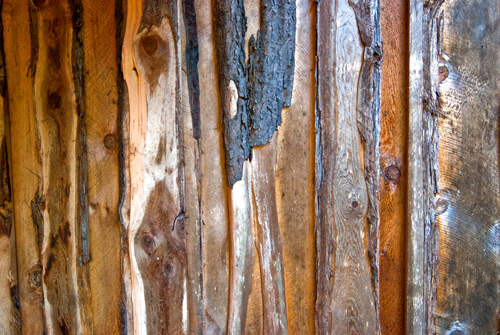
As you know, we love modernism around here; but modernism also comes with some baggage. There’s a tendency to think that all things modern must be stark and white and free from irregularity. And while this philosophy of modernism appropriately applies to designed objects in the vein of cell phones, cars and appliances, it doesn’t quite apply to everything in the built-environment. An authentic and honest connection to architecture doesn’t necessarily imply perfection. The connection may simply be a worn leather handle of a door or the mill-scale on a steel handrail. These  pretenseless and subtle details allow for a relationship to the work; they offer an understanding. Lately, we’ve been incorporating more of this into our own thinking: this idea of introducing more grit, more truth of material, and basically more nature into the work.

Allowing nature to play a more prominent role in the work is a delicate dance. The details and subtleties should still occur within the framework of a modern philosophy. More specifically, the structure is still rational, the form still follows the function, and the ornament, if any, still needs to be an expression of something purposeful.
The more time we spend doing architecture and building, the more we realize that nature has, in most cases, already worked very hard to produce remarkable results. It would be a shame, for instance, to cover up the handsome grain pattern of a piece of hardwood. Additionally, over-designing the construction process to eliminate the naturally occurring variations in a concrete pour would be equally unfortunate. On the other hand, become too casual with these details, and serendipity rapidly deteriorates into an aesthetic of carelessness – it’s a balancing act.

Recently we came across a structure that struck a chord in us with regard to this idea. Tucked away on the grounds of the Whidbey Institute, on Whidbey Island about a half hour north of Seattle, we came across this modest Sanctuary. While unassuming from the exterior, a peek inside opens up an entire narrative of carefulness, thoughtfulness and letting nature play a role. While we don’t necessarily consider the Sanctuary to be modern in a pure sense, it’s difficult to discuss the Sanctuary without talking about modernism.

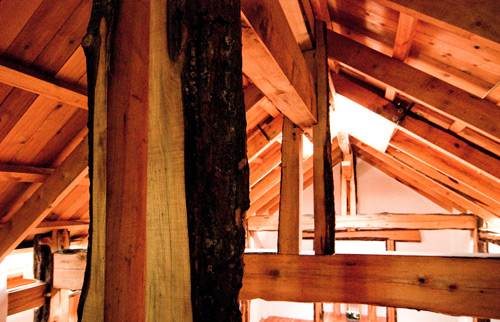
At first glance the structure appears traditional in form, but upon deeper investigation it plays by many rules of modernism. Exposed floor boards sit on exposed purlins, which sit on exposed joists, which align with wall posts, which inform the window geometry. Everything lines up. Every element is an authentic expression of its functional role. The Sanctuary is everything it needs to be and nothing more. The builder even utilized some of the materials from the site to build the Sanctuary. Not only is this the heart of modernism, but also sustainability.
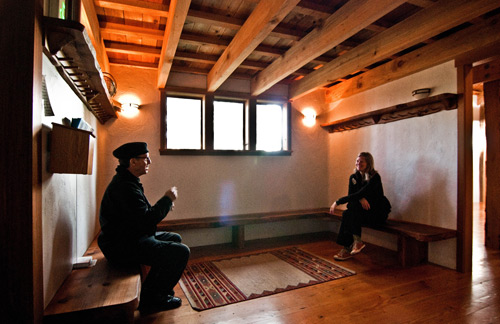
You may have noticed there’s an added level of poetry within the Sanctuary. The yellow cedar main framing beams are cut to certain dimensional sizes which allow the curvature of the log, the irregularities, and even the bark to sneak through on occassion. It adds a level of wonder and curiosity to the overall composition without compromising the principles of modernism. This move is performed only where it matters – at the main roof framing members where the visual is most noticeable and at the columns which can be touched, smelled, and studied up-close. The visual discipline that keeps this method from extending to the roof purlins and the smaller framing members is apparent; there’s an aesthetic code which is all part of the delicate dance. The designer was judicious, understanding precisely how far to go without taking it over the edge. And understanding when to let nature do the work.

To create a strong architectural language, understand material limitations/possibilities with precision, and mill the lumber in addition to simply building the Sanctuary is a rare feat for a single individual. And the individual deserving this credit is the designer and builder of the Sanctuary, Kim Hoelting, who has our full respect.

And just a stone’s throw away sits a stone labyrinth in an open meadow, a fitting complement to the Sanctuary.


Cheers from team BUILD

8 Comments

  • By Damian, December 20, 2011 @ 7:00 am

    Guys,

    You article touch a chord. Very interesting work by Mr. Hoelting.Very well done, keep them coming.

    Quoting Le Corbusier:

    ‘You employ stone, wood, and concrete, and with these three materials you build houses and palaces. That is construction. Ingenuity is at work. But suddenly, you touch my heart, you do me good, I am happy and I say: ‘This is beautiful.’ That is architecture. Art enters in. My house is practical. I thank you as I might thank Railway engineers, or the Telephone service. You have not touched my heart.
    But suppose that walls rise toward heaven in such a way that I am moved. I perceive your intentions. Your mood has been gentle, brutal, charming, or noble. The stones you have erected tell me so. You fix me to the place and my eyes regard it. They behold something which expresses a thought. A thought which reveals itself without word or sound, but solely by means of shapes which stand in a certain relationship to one another. These shapes are such that they are clearly revealed in light. The relationships between them have not necessarily any reference to what is practical or descriptive. They are a mathematical creation of your mind. They are the language of Architecture. By the use of raw materials and starting from conditions more or less utilitarian, you have established certain relationships which have aroused my emotions. This is Architecture.’

  • By Keiser, December 20, 2011 @ 7:28 am

    What a wonderful place, thanks for posting on this sanctuary. It’s out of the way enough that something like this might not typically get picked up in traditional media. Cheers to blogs!

  • By Caitlin Walsh, December 20, 2011 @ 8:39 am

    Wonderfully written blog post, kudos! The photos are great as well, would love to jump scales and see more intimate construction details.

    @Damian, thanks for the Corb quote, very appropriate as related to this post!

  • By mod, December 20, 2011 @ 12:44 pm

    It’s hard to ignore the naturally occuring and beautiful properties of our favorite building materials here in the Northwest! I HEART CEDAR AND DOUG FIR AND JUNIPER.

    With respect to the Sanctuary’s connection to modernism: there is clearly an influence of traditional japanese building methods at play in the detailing and construction of the sanctuary. That same japanese design and construction heavily influenced american modernism as we know it today.

    Great article!

  • By Build LLC, December 29, 2011 @ 1:23 pm

    This just in… the incredibly talented Ross Chapin was also involved with the Sanctuary ; apparently Chapin and Hoelting have worked on a number of projects together: links here and here
    -a big thanks to Karen for the scoop

  • By bill shannon, January 3, 2012 @ 9:24 am

    Thank you for this article. The intentional incorporation of natural surfaces into building materials is an important complimentary thread to the central spatio-temporal state of architecture in relation to humanity. To promote within the modernist aesthetic the natural state of materials as “perfection” is appropriate for our post 3/11/11 21st century condition. The sterility of the “Dwell Home” of the past decade is accentuated by the glass walls it holds up against the forces of nature which surround it. While the buzz has been to eliminate the division from inside to out the materials used to build the break in the divide have remained, for lack of a better term, stark in quality. Tarkovsky’s book Sculpting In Time comes to mind especially his discussion of aesthetics. Have been enjoying reading and referencing this blog for a year now after googling corrugated siding + patina + architecture. keep up the good work.

  • By Kim Hoelting, January 6, 2012 @ 7:15 pm

    Your insight into our process is really quite remarkable, and I am humbled by your commentary. The design and construction of the Sanctuary was a kind of babtism for me; a deep cleansing. It was a conscious process of outwitting the ego, and an invitation to really listen with the heart while at work. With gratitude, Kim Hoelting

  • By gail howard, January 19, 2012 @ 9:28 am

    I love seeing the modern takes on this topic, especially here in the Northwest with our amazing natural surroundings.

    There’s a wonderful book about mid-century designers and their appreciation of the handmade:

    Handcrafted Modern: At home with Mid-Century Designers

Other Links to this Post

Leave a comment