

We’re all familiar with the design philosophy of Form Follows Function coined by the architect Louis Sullivan in 1896. It was an important paradigm shift in the design world and more than ever, in our modern times, the shape of a building or object is primarily based upon its intended function or purpose. This has always made sense to us; a building should look like what it’s doing.
In exploring the relationship between how a building looks and how a building functions, we’ve been taking the philosophy a bit further; to include the material that the object is made of. The idea is that the form and the envelope material articulate the functions within. If nothing else, the form and materials should differentiate the functions. While this is a focus in most of our work, we’re using the Bellevue residence for today’s example; it’s in a great stage of design development to illustrate the idea.
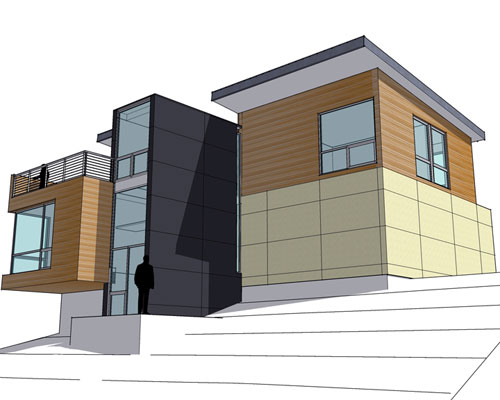
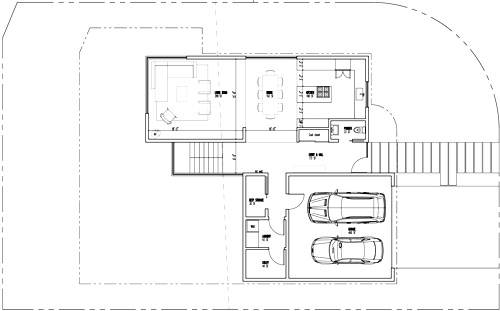
The house consists of two levels; the main floor contains the common areas (living, dining, kitchen) and the utilitarian areas (garage, utility, laundry) while the upstairs contains the private bedroom and bathroom areas. A center volume handles the circulation between the floors and functions.
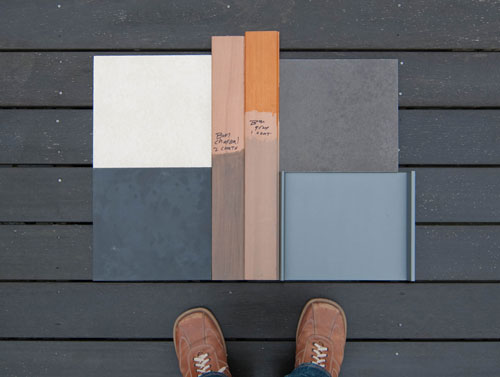
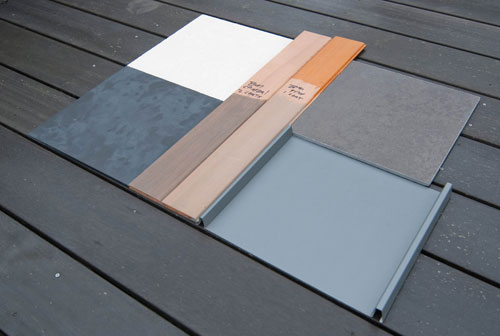
We’re proposing to separate the walls of the envelope into three material groups.
A rainscreen concrete board system clads the garage and utility areas. This particular engineered material is installed in 4×8 sheets and has a machined, industrial feel to it. It’s also very durable and requires little maintenance.
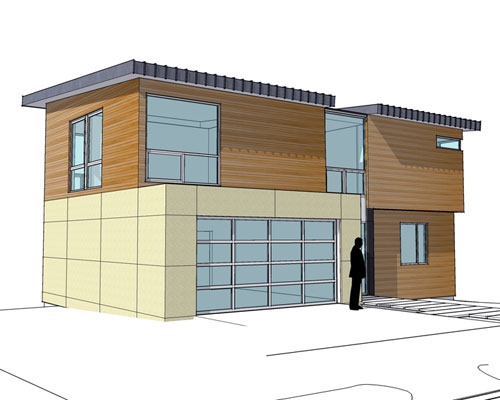
The living spaces are wrapped with a horizontal T&G clear cedar. The cedar gives a warm, intimate feel to the envelope and adds to the serendipity of the entry. The cedar tends to be a bit more precious and is subsequently used at the areas where it matters most.
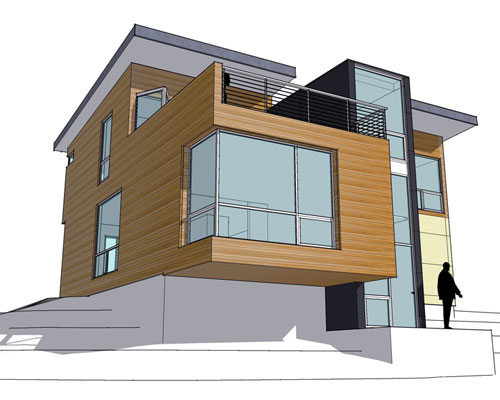
A third material envelopes the center circulation volume and reflects the service nature of this area. A panelized material is used to reflect the formality of the interior use.
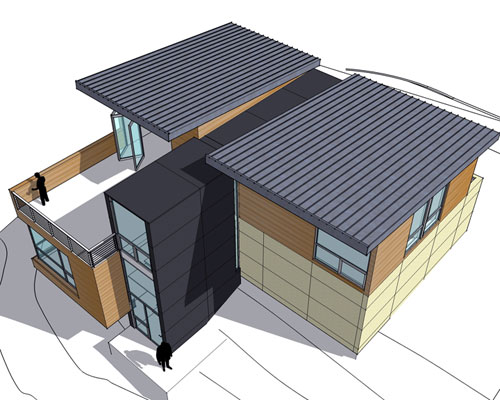
A consistent standing seam metal roof is used at the shed roof structures while a membrane is used at the “flat” roof above the circulation space.
There are, of course, a variety of second level materials (aluminum at windows and doors, concrete at the foundation, etc.) but you get the gist of it.
We find that this method of designing is sensible because it’s based on strategies and rationale. It keeps the decision making process simple and allows for a linear design process. Best of all, it provides reason; the owners and design team know why something is what it is.
…always interested to hear your thoughts and ideas.


Nice simple house. Any thoughts yet on how you will maintain/articulate the flush condition between the cedar siding and the rainscreen panels?
Good post. It drives me nuts when the entirety of a house is covered in the same dumb material regardless of what’s going on inside.
It’s been pretty dang cool to watch the development unfold on this project (via your blog). Thanks for the thorough coverage and I love the latest renderings.
Nice post, you mention the cedar being “a bit more precious and subsequently used at the areas where it matters most,” however, the cedar is the most dominant material at around 60% of the vertical surface area. Is there a reason for this?
Have you considered using Richlite for any of the exterior cladding? They have a new rain screen program for their material called Rainshadow. It has been used as interior and exterior cladding extensively here in MN and has held up tremendously to the harsh elements and wild temperature swings. It would also be a local product in your area.
@Sean -by the time we detail it out, the two siding systems won’t be flush. It makes sense for the rainscreen system to be a bit proud of the cedar and we handle the transition with a minimal flashing cap.
@Ryan -good question. The cedar is more prominent at areas where a person might be close up to the house; like the usable yard areas, the entry, the roof deck, etc. Also, we think that the the texture and detail of the cedar better accommodate the living spaces as it’s warmer and more serendipitous. The combination of these two factors make the cedar the most prominent material at the siding.
Have you run into any difficulties from building inspectors when you use multiple cladding options on a single structure? This is something that I am just now starting to see where I practice. The building inspectors are starting to demand building envelope engineers for even single family homes. It appears that some building inspectors aren’t willing to approve multiple siding applications without third party approval. It’s starting to get very frustrating. I worry that the bureaucrats are starting to get out of control.
@ Cameron -haven’t had difficulties with that yet here in the Pacific Northwest. Where are you practicing? Sounds like a real pain.
Toilet at the front door? Very convenient…but…Had to bring it up…why not put it in the utility space off the garage entry somehow?
The rest of it, and of what your topic is really about, nice.
I’m in Vancouver, just North of you. Some of us are starting to wonder the point of having building inspectors, as they aren’t willing to make any decisions.
@Garrett, a powder room by the front door is very handy for guests. It’s an arrangement you used to see very frequently up until recently. I’m glad to see the concept making a return. I put one by the front door of my own home.
enjoy your Blog. also an architect up in Vancouver. The standing seam is more common in the US than Canada. Up here it is quite the premium. A friend did do a similar shed condition but had trouble with the incorporation of the gutter. check it out – good accommodation if you come up to visit us. http://www.ecoloft.ca/
I’m more of a skin follows form kind of guy. You have 3 distinct forms in possibly two ways. Could be seen as two separate volumes divided by the circulation spine or two similar volumes divided by a circulation spine and a cantilever. Therefore you could cut the cantilever as a separate volume by using a negative joint with the material that is being utilised in the circulation form only between the start of the overhang and the start of the upper story section. (LH elevation of the 5th image)
I see three distinct skins. Just me.
Still very much like it though.
@amr -one of our siding iterations did exactly that, separated the volumes into 3 distinct siding types. It looked sharp, very rational but there’s something about the added warmth of applying the cedar siding to living areas that we liked better. And, after all, architecture is all about post-rationalization.
@Scott I see metal roofs comanding a premium price point in Portland, Oregon. I think it’s just something roofers know they can get more money for (though in defense, it is a trickier install than shingles)
Build (and anyone else): I’ve had a question about cedar for some time…it’s a lovely material when stained and sealed. It’s rot resistant, which is great too.
However, my experience has been that it takes a fair amount of maintenance to keep it the warm orange color spec’d by so many architects. This gets even more challenging if the material is high up on the building.
Am I missing something here, or are we all expecting the homeowners to stain/seal every other year or so?
build, just curious, was the owner of this house inspired by the Davidson residence, the central volume seems inspired by that project?
http://www.buildllc.com/#mi=2&pt=1&pi=10000&s=0&p=0&a=0&at=0
@Lou, there is certainly a lot to like about the Davidson residence. Our central volume is based on a few goals: 1) a long sight line from the entry to the a green filled view of the park along the rear, 2) a prolonged sense of entry where we could play with art and light as visitors transition to the living area, and 3) a strong central organizing mechanism that plays both inside and outside.
@ Shawn Busse, cedar can become a high maintenance product when maintaining the brightness of new cedar is the goal. I prefer to let cedar go untreated and develop a patina as it ages. I know many people don’t like this but I prefer the honesty of the natural material aging and colouring in place. I personally think the cedar lasts longer when it is untreated and is allowed to breathe. Nothing like the pewter hues of aged cedar.
thanks Jay!
Following up on my off-topic discussion…
You guys are awesomer than Bob in many ways, but on this one I am with him…Thank you so much for spending the time to do your blog.
http://www.lifeofanarchitect.com/toilets-by-the-front-door/