

Our Special Projects Division shop just completed the design, construction and installation of a custom bed for a recent project of ours and it’s got us thinking about furniture, building things by hand and timelessness. In the age of assembly lines and mass produced furniture, there is a tangible quality to something built by hand in a wood shop. Call us luddites on this one, but when it comes to the furniture that you touch and feel each day, there is a significant value in having something in your home crafted by a person (rather than a machine).
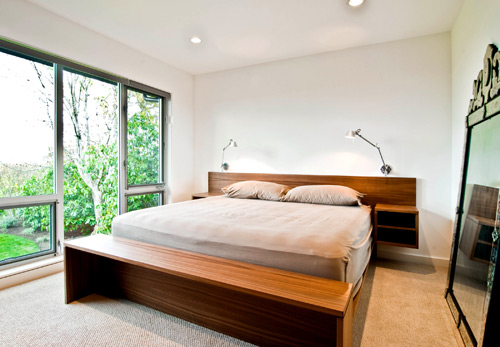
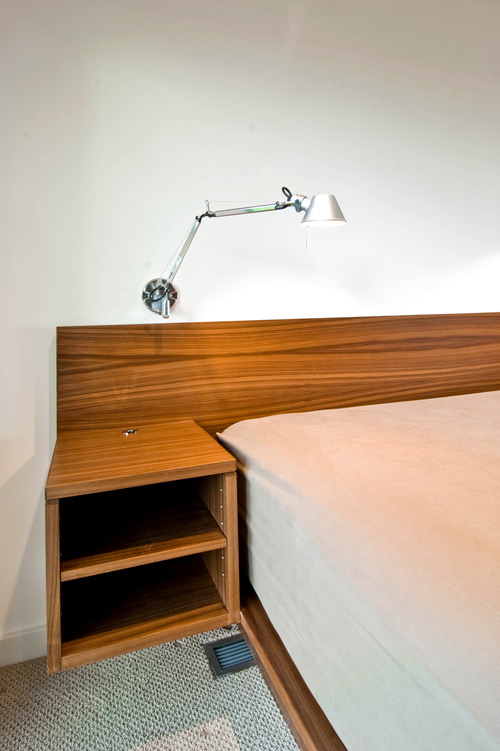
The piece is made from quarter-sawn walnut veneer with solid edge-banding; it includes an integrated bench at the foot of the bed and storage cubbies on each side. The design is simple and straight-forward, it’s everything it needs to be and nothing more. While not overly special or precious, this piece of furniture may very well be a fixture in the home for the life of the house. And nothing would be a greater compliment to us.
With the holidays upon us, it’s a great time to rekindle the act of building something with your own hands. There’s also no better gesture than giving something filled with the intention and care that comes with a hand-built gift. For the holiday season we propose rolling up your sleeves and getting your hands dirty. Build something, make something, put some materials together. It could be as small as a set of children’s wood blocks or as big as a piece of furniture – what it is, is hardly the point. It’s about unplugging your hands from the keyboard and re-engaging with the primal act of making.
Check out what we’re doing in the shop via Twitter.


I couldn’t agree more with the sentiment of this post. It’s so easy to get stuck in the routine of our days and miss out on the satisfaction of creating something tangible. And it’s equally easy to rely on technology that generally makes life easier or our work better, but it feels like something gets lost by having things go faster. Reminds me of a Times op-ed I read a few years ago from Pentagram’s founder: http://www.nytimes.com/2009/02/08/jobs/08pre.html
i concur wholeheartedly.
custom-built cabinets in my home and shop by BUILD SPD bring me an immeasurable amount of satisfaction, every day.
very handsome bed. and i love the cell phone/electronics hole to hide the cord(s).
Beautiful bed… you have a very lucky client.
Hand-made is certainly a rare commodity these days – as is the craftsmanship that we associate with it.
There is a bit of a false contrast created, however, when we paint the relationship between the hand-made and the machine-produced in black and white.
Most of us lucky enough to be engaged in “the primal act of making” do it with tools like routers, skilsaws, miter saws, joiners, nail guns, compressors, impact drivers, hole hogs, table saws, sawzalls, grinders, and (if we’re lucky) fein saws. All of the above qualify as “machines”, but in most peoples minds their use does not necessarily disqualify the work from being “hand-made”.
Add to this the fact that these beautifully crafted pieces of cabinetry, casework and furniture are produced based on shop drawings typically done on a computer, often by the craftsmen themselves, and we add even more ambiguity to the mix.
All of the machines mentioned above, from nail gun to computer, are operated by hand… quite literally. The useful distinction, then, might not be between hand vs machine made, but rather custom vs mass produced? Even then, cnc and rapid prototyping blur the boundaries…
Regardless of where each of us chooses to draw the line (if there is one) I think one thing is clear – as our tools become more advanced, craftsmen must also become more advanced to keep pace and ensure that the work itself is executed with the same level of craftsmanship associated with work done using simpler tools.
The cost, both in time and money, of keeping pace with the technological frontier of our “tools” can be a heavy burden, and few of us have the resources (and bandwidth) to keep up. For this reason, many makers choose to justify their own resistance or inability to master the most advanced tools by reinforcing a false contrast between the hand and the machine.
Apologies for the long response, but your excellent blog just got me to thinkin’.
@ Shane – that’s some good thinking. You bring up some great points and “custom vs. mass-produced” might be a better way to phrase what we’re after. One thing that always illustrates the process of a piece of custom furniture is watching the craftsman hand select the boards and deliberately align or sequence the grain patterns. Not something you see much in mass-produced woodwork. How the grain patterns relate (or don’t relate) is always a good indicator of person vs. robot.