


Why Design-Build is so good

We’re often asked about the advantages of design-build over the conventional system of architect and general contractor. It’s a great question and with over a decade of design-build experience under our belts, we feel like it’s a good time to call out our top ten reasons why the design-build system is so good.

1. Everybody is on the same team: We’re all in this together and we all have the same goal –to arrive at a successful project that meets or exceeds the client’s expectations for their project. When challenges are encountered on a project (and there are always challenges), pointing fingers is not an option, everyone rolls up their sleeves and works on solutions.

2. Total accountability: One entity is accountable for everything –including how the end result looks, how much it costs and the timeline of completion. When the same group that designs the project also builds the project, there tends to be much more attention given to pricing and scheduling in the design phase. The cost of everything is taken into account early on in the process; all fees, construction costs, utilities, landscaping allowances –everything.

Unfortunately, it’s not unusual for us to hear from people that “their remodel cost twice as much as the architect said it would” –such a scenario is entirely unacceptable in the design-build world. Design-build focuses on results, not excuses.

3. Continuity: A design-build firm is involved from start to finish, which adds an inherent efficiency. The chance for things to fall through the cracks is greatly diminished.

4. Expertise: Design-build firms are experts in both fields. The principals should be licensed architects with formal architectural training and experience in the architecture field. They should also have professional experience in construction and understand pricing, sequencing and how buildings go together. If they’re anything like us, they have professional structural engineering experience to boot.

In the new economy we’re noticing architects trying a bit too hard to look like design-build operations without having any field training. Likewise, we’ve raised our eyebrows at a few general contractors who claim to, all the sudden, be accomplished designers.

There is a tremendous advantage to working with architects that can think like builders and builders who can think like architects, but design-build is a commitment, something you dedicate yourself to for an entire career –not just when it’s convenient.

5. Professional guides: We’ve all heard the stories that design and construction can get out of hand and messy. Design and construction shouldn’t be chaotic or stressful. A design-build firm is a beacon to clients throughout the process, guiding the way to the best possible outcome. Design-build refines a system from beginning to end and manages the chaos into orderly steps.

6. Involvement: Design-build operates under the assumption that the client actually wants to be an active participant in the design and construction of their home. By taking an involvement they’re guaranteeing that they get the outcome and satisfaction of their goals – what they want is going to be achieved. We’ve found that such an involvement is inspiring and gives people a lasting sense of pride about their home.

7. Collaboration: Design-build cuts out the big egos so common in the design industry. In design-build the client retains total control over the project and the team is there to empower them.

8. The best kind of communication is open, honest and often: Design-build is transparent because we want clients to understand the process and to know what’s going on. The best partnerships work, not because people say what everyone wants to hear, but because they say what everyone needs to hear. Through clear communication the budget is defined early on and it becomes the agreement for the entire project.

9. Time is of the essence: Design and construction involves managing hundreds of timelines that need to coordinate in lockstep. Design-build creates opportunities for clients to sit with big decisions, ask questions, and consider their options. Anything the team can do to avoid taking steps backwards is going to lead to better, faster and more cost-effective results. The design-build system is highly adaptive and responsive in the field. Big decisions can be revisited during construction without change orders or additional fees. The conventional story is that if you make changes it will cost you money – not necessarily so in design-build.

10. Cost savings: Inherent to the design-build model is a savings of approximately 10% of the project costs. We’ll save the details for a future post but here’s the quick hit:
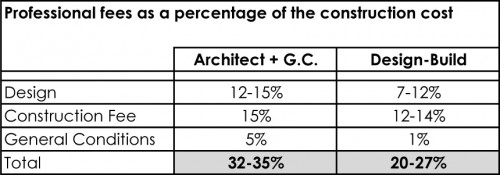
* Disclaimer: it’s possible to have nearly everything above with the traditional system of architect and builder; it’s just that we so rarely see it.  Typically it takes architects and builders decades of working together before they reach such efficiency with communication, mutual respect and trust.

Happy labor day and cheers from BUILD

14 Comments

  • By Gilman, September 6, 2010 @ 8:33 am

    All good points that help a homeowner like myself evaluate and compare systems. I’m finding that there are a lot of different types of DB firms though -maybe you could speak to that a bit. For instance some DB firms actually swing hammers, others don’t.

  • By Knudsen, September 6, 2010 @ 8:35 am

    11. Respect: design-build firms tend to respect the trades and foster their business relationships with them. I’ve seen far too many architects treat the trades as if they’re disposable.

  • By Madison, September 6, 2010 @ 8:41 am

    I think there is a case to be made for the traditional architect + GC system. I’ve seen a few owners over the years who don’t want a huge involvement in the project, are willing to pay a premium, and allow the architect to run the show. I’m not saying it’s better or worse – just a niche market where design build may not be the best solution.

  • By Mike D., September 6, 2010 @ 9:26 am

    Having just completed a home with Build, I agree with all points above. Further reading on the subject here: http://www.ahousebythepark.com/journal/archive/2009/06/30/to-gc-or-not-to-gc/

    One other thing that strikes me is that when you use two firms, the end result is a multiplicative equation. Skill of architect X Skill of GC X How They Get Along Together. In order to get a good result, you need at least 90s across the board (.9 x .9 x .9 = .72 … or roughly “72% success/happiness” we’ll say). If just one of those factors drops to say, 50% or lower, you can see the effect it would have on the end project. I know the math analogy isn’t perfect, but I do think if you hire the right design/build firm, your variables go way down… and that’s valuable to the end result.

  • By Becky / @ecomod, September 6, 2010 @ 12:31 pm

    I was just explaining this to a client the other day. Glad to have a clear resource to send the next one to!

    Good article, & I agree that having the same team start to finish is the best way.

    cheers -

  • By ksa, September 7, 2010 @ 9:52 am

    I understand what you are saying, but Build llcc is an exception not the rule in the design build world right now. I would say that most design build companies are driven by contractors who have no formal design training.

  • By Jim, September 8, 2010 @ 1:09 pm

    Having worked for a design-build firm myself in the past [ http://www.made-nyc.com check 'em out ] I understand all of the benefits for the client AND the design/construction professionals.
    What I can’t figure out is where to find good ones. Too often I search online and find only firms that are big corporate machines practicing their corporate version of design-build. Do you know of any good resources listing small d-b firms? I am on the lookout all the time when browsing design blogs as I am looking to relocate/restart my career. I can never find a resource for locating more than one good design-build firm at a time.

  • By Joseph, September 9, 2010 @ 5:51 am

    Hey Guys –

    Great explanation of the advantages of design-build for project delivery. You have made excellent points, all of them valid. I did some small-scale DB earlier in my career, but have now moved to a more traditional Architect-GC-Client model. Here is the one disadvantage to design-build that I could never get around.

    In the traditional Architect-GC-Client structure, the architect works for the client exclusively. Sometimes this means going to war with the GC over the cost of a change order or the acceptability of a solution for an unexpected condition. Happily, for me this does not often happen – I mostly work with GCs I have known for a while and have a good relationship with. But even with these guys, I sometimes get a CO that I have to ask them about – why so much? In those cases, I either get an explanation that I accept and can take to the client, or a different approach to the solution and a lower number. I like the clear understanding that I am the owner’s representative and have no conflict of interest regarding the contract amount or scope.

    Did you guys see that Seinfeld where George is talking about how frustrating it is to take his car into the shop? His complaint is that when you go to get your car: “They can say anything! Like, you need a new Johnston Rod. What am I going to say? I don’t know anything about cars!” What the design-build model means is that when it is time to talk about resolving unanticipated issues (or client-driven changes), the architect ends up being the only one in the room who really knows what’s going on.

    It is true that this can be an okay thing. It always was for me; I felt like my role in the process was quasi-sacred: these construction-neophyte homeowners had entrusted me with their money and their dreams, and it was my duty to deliver the work with as high a quality and low a cost as I possibly could. But it also felt like I had had slipped on the ring. Now, you can wear the ring for limited amounts of time without hurting yourself or the client, but if you keep putting it on, you expose yourself to a dangerous amount of power. I think it is probably analogous to exposure to radiation, or smoking cigarettes; some people will be unaffected, but others, less so. Gollum is an extreme example, but I think you know what I am talking about.

    From what I have read of your blog and seen of your work (both dynamite, by the way), you guys may be of the kind who are inured to this. But I can think of one outfit here in Seattle that did a (beautiful) remodel for friends of mine. When my friends showed me the contract documents and change orders, it gave me a very uncomfortable feeling. Oy. What to say to my friends in this situation? Nothing, of course, they were very happy, and it was a done deal. But still.

    As I have said; I love your blog and your work, and wish you well in all future endeavors. But I think it is important that when you talk about your methodology, particularly to other architects, that you recognize this issue and talk about your approach to dealing with it.

    Best regards, Joe

  • By KP, September 15, 2010 @ 8:57 pm

    Joseph – I think your point is an obvious one and should definitely be considered by a client before they go with the design/BUILD approach. However, as a first time remodeler (and happy client of BUILD LLC), I can say that the guys stuck to the budget and timeline we gave them and were our advocates with the subs from start to finish. 18 months past completion date, they are still willing to take a call and get the subs to tweak elements when they need fine tuning. From start to finish, they watched the pennies as if they were their own and battled any subs who wanted to weasel their way into some more money on our behalf. The design/BUILD approach definitely worked for us.

    My subsequent experience with a well-known design firm who was independent of our GC on a commercial project I was involved with was the opposite. They didn’t design within our cost or time constraints unless we forced them to, and we found the GC ended up being the better advocate for sensible trade-offs between design and time and cost. Again, I’m not a professional, but with the right team in place, the design/BUILD approach can be a very good solution.

  • By Joseph, September 17, 2010 @ 8:00 pm

    Thanks, KP – sounds like a great deal all-around. And you are right – When it works right, DB is a magnificently effective system.

  • By don, February 21, 2011 @ 5:05 pm

    Hi Build,

    What is your reasoning for showing general conditions at 1% for db vs 5% for arch+gc?
    Theoretically, they should be the same.

    Also again on theory, if markup [fee] correlates to risk, why would db charge less fee than a gc?

    Don

Other Links to this Post

  1. Build Blog » Why Design-Build is so good « just do something… anything — September 6, 2010 @ 5:43 pm

  2. As We See It : Design-Build's Advantages — September 8, 2010 @ 9:47 am

  3. G2 Builders: Why is Design Build So Good? — March 26, 2012 @ 7:44 am

Leave a comment