

You’ll never get sued for ugly

It was a frequently used phrase by one of our professors back in school. What he meant by it was this; as architects and designers we’ll always be liable for everything except aesthetics. City planners will evaluate a project’s zoning and height restrictions. Building officials will scrutinize the structural and life-safety design. Inspectors will analyze the electrical, plumbing and mechanical systems. Health inspectors will scour over the food service requirements. From the sidewalk curb down to the energy efficiency of each and every window, there are codes to meet and agencies to satisfy. As a professional, you can be held liable for a daunting number of issues. How the building looks, however, is not one of them.

There is a powerful undercurrent to all of this. Since there aren’t any state or city agencies enforcing good aesthetics on designers, it is precisely the designers that become the guardians of aesthetics. No one is going to make us architects uphold a visual code, it’s up to us.
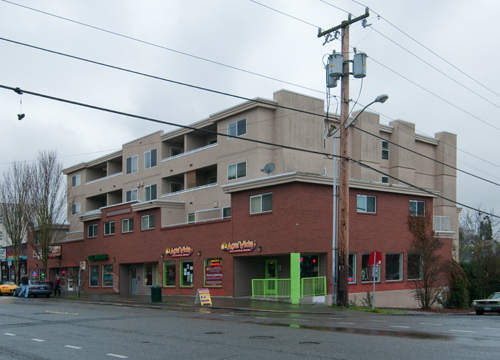
We appreciate the freedom from regulation of aesthetics and would find it awkward if an agency were enforcing codes in the realm of aesthetics. At the same time, the abundance of aesthetically negligent buildings in the built-environment is alarming, cover your children’s eyes so they don’t see it, threat level orange alarming.
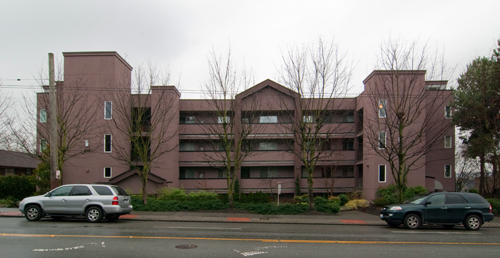
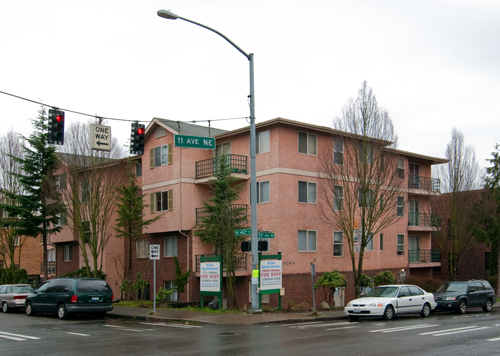
Team BUILD recently went on a neighborhood walk-about and began documenting buildings that, in our opinion, are aesthetically negligent. As it turns out, there are key ingredients to the recipe of aesthetic negligence. Topping the list is the complete lack of any driving idea or concept. A close second is having no relationship to time (like the present one) or region (like the northwest).

Following close behind is the architectural movement known as “a mixture of various globbed on styles from bygone eras and distant places”. The inclusion of roofettes is high on our list as is stucco, which always seems to have a starring role in these buildings.
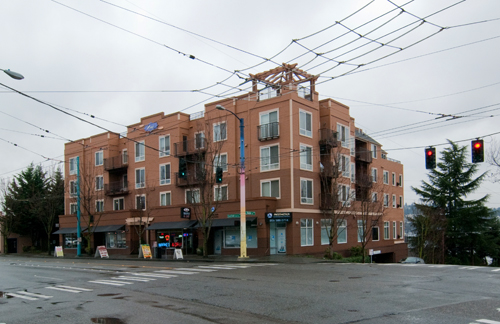
When these buildings actually include outdoor space they are peel-n-stick decks, jimmy-rigged to the outside. Even at the ground floor the connection to the sidewalk is vacant and the contribution to the street life is non-existent.

Most disturbing about these buildings is that, behind each and every one, is a licensed architect who at one point or another approved the drawings and stamped the permit set. Every one of these buildings was drawn up in elevation, unrolled on a professional architect’s desk and at some point they must have thought to themselves “yep, it’s finished, time to take this baby in for permit”. Dumbfounding.

In order to obtain a license in architecture, a minimum of 5 years of college level work is required at an accredited school of architecture. An additional 3 years of professional training is required under the supervision of a licensed architect. A nine part exam must then be passed prior to licensure. With all of the checks and balances along the way, it’s amazing that work this terrible is making it through the system. But contrary to rational thought, these buildings are flourishing, they’re popping up like weeds.
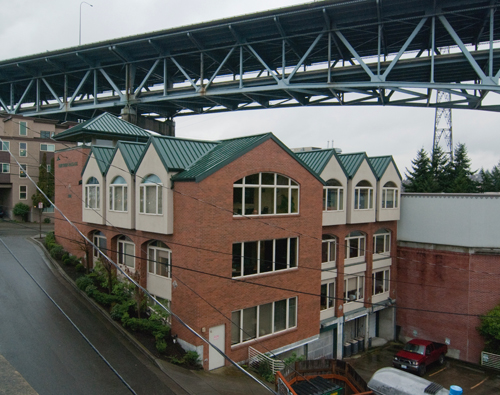
Our professor was right, you’ll never get sued for ugly. The evidence is everywhere and it would appear that the profession of architecture can no longer depend on it’s own process to ensure good design. As the guardians of aesthetics, if we fail to maintain a decent level of design in the built-environment, the freedom of design will gradually be taken over by review boards and covenants. Architects will lose the very authority that attracted most of us to design in the first place.
18 Comments
Other Links to this Post
-
Uglyness « natmussi — February 19, 2010 @ 6:23 am
RSS feed for comments on this post. TrackBack URI


By Gus, February 1, 2010 @ 11:12 am
I struggle with the same issues. While I don’t want my liberties as a designer managed, it seems like the only way to minimize the crap out there is through some sort of regulation.
By darin dougherty, February 1, 2010 @ 12:37 pm
Fantastic post gentlemen. I think this issue is secretly taught at the collegiate level unfortunately. Every student wants an ‘A’. To get an ‘A’, you need to do what the professor likes and requires. Students aren’t taught (or at least encouraged) to take a stand. In the real world, the developer is the ‘professor’. The architect is eager to make his professor happy. Replace the ‘A’ with a pay check. It’s easier to smile and nod than to take a stand and be accountable. Very unfortunate for society.
By Daniel, February 1, 2010 @ 12:46 pm
The standard level of design is appalling… but adding regulation would raise the cost of building anything — in a city (Seattle) that already has a lot of regs. and high-priced buildings.
Maybe if they (still thinking Seattle) had a system similar to DPDs CPA status, where you go through review for a few buildings and then, after you consistently show good design, you can skip the design review. Buildings would be reviewed after and bad reviews could force you to go back in to design reviews during permitting. Architects doing good work would be rewarded by more freedom and faster permitting (which could lead to either lower building cost or higher developer/owner profit) while those doing crap work would be forced to slow down and put out better design.
The problem with this would be how to decide what qualifies as good design without creating a template.
By Knudsen, February 1, 2010 @ 4:40 pm
The 95% of architects doing crappy work out there are really making the rest of us look bad.
By Matt Cole, February 1, 2010 @ 6:11 pm
In the absence of regulation, which is fraught with problems, I would argue that one of the reasons we have so many ugly buildings is that designers often play a small roll in the actual development process. You can nobly say no to such projects, but Joe the Developer will shop around until he finds an architect who will do what he wants – paying the bills can quickly trump ideals. Things might improve a bit if more architects moved from being fee-for-service providers to actually initiating or becoming financial partners in development projects. That way the design of a building can’t so easily be reduced to whatever is quickest to build, is “appealing” to the broadest segment of the population (those buildings you photographed weren’t empty), etc.
By mike, February 1, 2010 @ 7:58 pm
if you think these are bad, you should check out the horrendous mid-rise/mixed use projects driscoll, et al. threw up (literally) in the I.D.
doesn’t denmark’s AA actually push for promotion in excellence in design for community, developers, etc. as well as improving conditions for architects via legislation? that’s how it was described to me, as opposed to say – the AIA which is becoming less and less of a benefit to members.
the idea’s been thrown about before, but a design review board with actual teeth would go a long way. and higher design standards for city buildings are a benefit to the end users as well as the developers.
probably the best way to ensure buildings meet a standard of design would be competitions… but the u.s. industry isn’t really set up to work this way. there are politics to competitions, but in general the result of a competition is several times better than just a standard commission. i can always dream…
By joshuadf, February 1, 2010 @ 10:23 pm
The building on the left of the photo with Tracy’s Hair Studio is a completely generic apartment building (Adria I think) that I’ve pointed out to people as “generic done right.” I don’t particularly like or dislike it, but it sticks to generic and has great street presence of little shops. I’ll trade generic for ugly any day.
By nc, February 2, 2010 @ 5:02 pm
Some of these ugly building are resold several times and making profits for developers , investors and realtors (6%?). The original architect is not rewarded a cents in all these transcations.. but once there is a problem 10 years later a lawyer will be looking for the architect/engineer about a design defect.
By Samuel, February 3, 2010 @ 10:46 am
You’ve nibbled on the edges of this subject before, but thank you for calling this out, plainly. There is no joy, no promise and no benefit to any of these buildings, besides the spartan mission of shelter. I just can’t imagine it would cost much more to do this much better.
By GS, February 3, 2010 @ 4:41 pm
while i totally agree with every word you said, one can assume we are all like-minded individuals with similar tastes. ie – design is purely subjective . there is no way a subjective part of design can be enforced by any agency, as they only enforce OBJECTIVE portions of our work. someone thought this was good or just didn’t care what it looked like. unfortunately for the built environment, they can do whatever they like.
By Spartacus, February 4, 2010 @ 9:33 am
In Stockholm, Sweden there is an agency called the “beauty council” that has some power over any new proposed aesthetics of the city. This a government agency that, I believe, many architects there consider a hinderance to what they want to achieve. There is very little ‘architecture’ of any revolutionary character that has been built there beyond the 1970s partly because architects are required to submit to these ‘concepts of beauty’, (and partly also because there is a societal trauma from modernist demolitions of old buildings in the 50′, 60′s and 70′s). Obviously the politics of any city is different from another, but I believe that in some cases, a government organisation will give you very moderated architectural statements, and what you are left with is having to work within a framework that has a very blase attitude about contemporary architectural values.
By Ryan Carpico, February 4, 2010 @ 8:48 pm
Most buildings never look as good as they did the first time the architect conceived of them. A few projects make it through all of the layers of client, regulatory and budgetary mandates with a clear vision intact – those are the ones we see in the trade journals and bouncing around the blogs. Many of the other 95% never have a chance because of what Matt is referencing – the ability of a developer or client to shop around for someone to implement their vision-less ideas.
Design review boards don’t present an appealing solution, though they do work to control quality in some cases. The infiltration of ‘green building’ ideas into mass culture has the potential to influence smarter design, as the clients better understand the purpose of integrated design. But that doesn’t guarantee good aesthetics. More evidence that good design sells could also provide influence in the battle for thoughtful aesthetics.
By Donald, February 4, 2010 @ 10:43 pm
Everyone here is rightly proud of this post, and it is sure a college try, but it still falls sadly short.
For centuries, public order was kept in civilized societies by public shaming rituals. This long tradition has deteriorated only recently– especially in show business and politics, viz. Palin, Hilton, Beck, and other assorted people who should have been thrown in rivers as infants.
Ah, but in art, architecture and design, shaming is still a powerful weapon! Look what happened when the all-powerful Damien Hirst stumbled into painting. Poor sod was ripped to pieces. My god, he must wet his pants now whenever he sees a tube of acrylic.
So, architects, you have yourselves to blame for all this dross! You are all too bloody polite. Yes, this has the makings of a bold post, indeed, and there’s even a little randiness coming through in the comments, but there’s no coup de grace. And without it, the problem will continue.
So name names. Point fingers! Shame them! And list the home addresses, and those of extended family members, of all the miscreants responsible for this aesthetic offal, these built obscenities. Only then will these offenders crawl back into their caves.
So, talk of a design commission is nonsense. There needs to be a vocal cultural elite keeping the riff raff off the stage. Much easier, far more effective, and perfectly in line with hundreds of years of high European tradition.
By Ioana, February 6, 2010 @ 1:13 pm
A lot of these are not so much ugly as undesigned / plain. I’ve been meaning to go photograph some really ugly stuff… what I mean by that is horrible design where you can see they actually worked on it and thought it was something. Gaudy mansions.
By andrew, February 8, 2010 @ 10:25 pm
Donald. Sound advice. I love it, hilarious. (And “sod” is one of my favorite words. Too bad Americans sound stupid saying it.)
Related: The other day Ted Smith told my friend/professor in an interview about ethical freedom, “I don’t have a website because I don’t want clients.” There you have the beginning and end of my aspirations: ethical autonomy.
By michael, February 11, 2010 @ 10:56 am
As I am sitting in my last semester of graduate school, I can honestly say that I know buildings like this will continue and society in large won’t give a shit. The reason is the same reason that my fellow students pump out thrown together projects that try to hit some key universally accepted moves then make a stale rendering of the one corner they designed, then call it good. It takes a lot of work and talent to make a good building and most people just don’t have it and have no desire to work to get it. This is ok and if it were the only issue, there would be no more hack architects because they would have switched majors long ago.
The issue, in my opinion, is that our society allows hacks to not only survive but thrive, and it is almost nonsensical to fight the fight for good design. I don’t know how to educate people and give them the knowledge to care, but I think this is the underlying issue. There are no good buildings without a good client and our system right now makes it hard to be a good client and keeps developers in their benzes.
By Marti, February 25, 2010 @ 4:06 am
In my country Spain, many city areas, villages, etc. have regulations that state certain rules for the buildings to be approved.
The goal is that the new buildings will fit with the existing built environment.
Rules include overall window proportions or limitations on the color of the buildings, type of materials, etc. Not all the limitations apply to all places, each one might have one or two depending on the most characteristic trend on that village/neighbourhood.
For instance, a fishing village where for centuries the buildings have been white will limit the type of buildings to White or very nearly white painted finishings.
In Barcelona, some areas limit the windows to have vertical proportions, since it is the predominant window proportion in buildings existing for the past 2 centuries.
It does not avoid some really ugly buildings to appear, but at least it helps to make them look a bit more integrated..
Nice post