

The Importance of Sketching

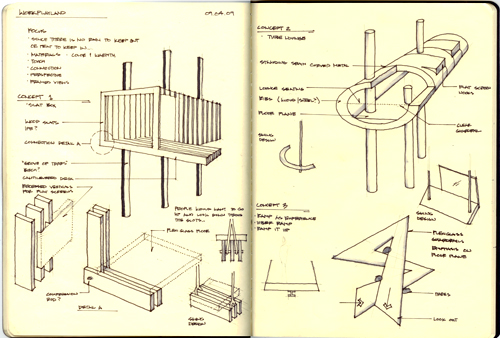
As much as we admire digital technology and as often as we employ it here at the BUILD world headquarters, there will never be a replacement for sketching. Knowing how to sketch as an architect or designer is a timeless prerequisite. We don’t care what amazing new software is on your laptop, we don’t care if you just downloaded the sketchpad app for the iPhone. While important, that stuff will continue to change. And at the risk of sounding like luddites, sketching will always be sketching. If you can’t sketch out a quick-n-dirty concept on a napkin, your role as an architect will be very limited.
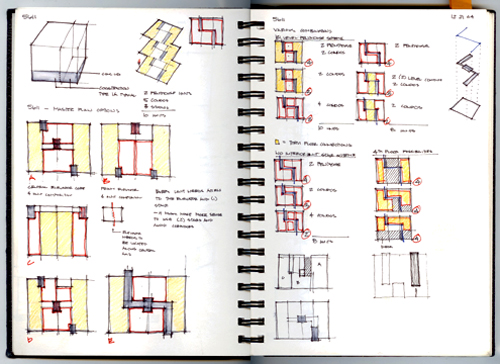
There is a value for 2D and 3D digital design in architecture but, in our opinion, it’s in addition to sketching, not in replacing it.  There are simply too many situations when you need to crank out a quick schematic sketch illustrating a concept or basic idea. Back-of-the-envelope sketches enroll clients in initial design concepts, a sketch on a spare piece of wall-board at the job-site quickly communicates a detail to the finish carpenter. There’s simply nothing as straight-forward as pen to paper (or gypsum wallboard for that matter).
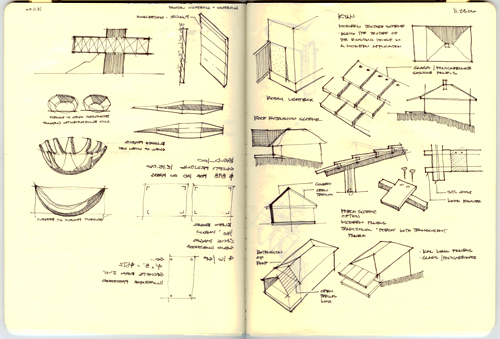
To us, the most exciting design occurs interactively, with clients and architects all at the same table talking, sketching and sparking creative design. So peel your eyes off the screen when you can and keep that sketchbook going.
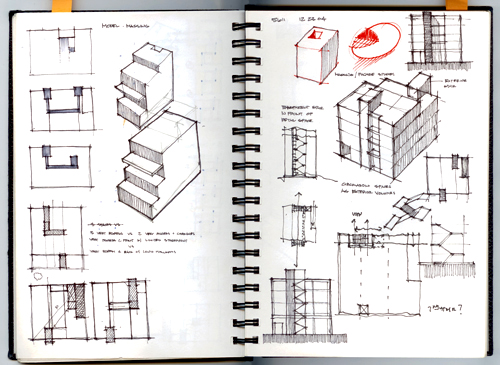
After years of sketching, our tools of choice are a Moleskine Cahier X-Large Plain Journal Notebook (3 for $15) and a Pilot Fineliner black pen ($1.39) – couldn’t be any simpler.
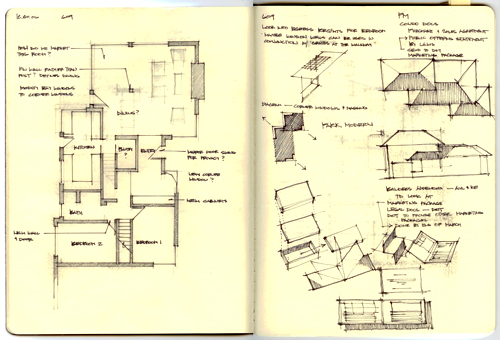
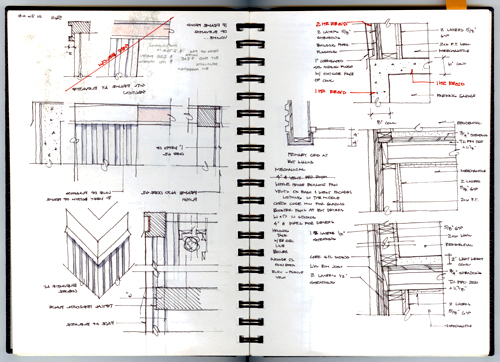
We’re no masters of the sketch but we’ve used what we’ve got for today’s post. Hit that comments button and share your favorite sketches with us.
18 Comments

  • By Richter, February 5, 2010 @ 8:56 am

    I’ve always found the sketches of Renzo Piano to be some of the most technical and informative out there.

  • By Knudsen, February 5, 2010 @ 9:07 am

    Good point guys, I like the ability of Santiago Calatrava – his sketches always seem very dynamic to me – they jump off the page.

  • By KUjared, February 5, 2010 @ 10:29 am

    Nice sketches guys, and as always great post. As a young professional and recent graduate the computer based design and representation has obviously become the media of choice. However, I still sketch everyday. The particular BIM program we use all day everyday at work takes 2-5 mins to save. I save very frequently allowing me just enough time to grab the Post-It notes and pen and sketch. I then take the best ones and stick them in-between my off hours sketches in the moleskin. I think the tools just got simpler…

  • By Christian, February 5, 2010 @ 11:36 am

    I love the impression a sketch leaves on a client. A sketch is conceived as incomplete, an idea in the making, something organic that will evolve over time. Where as digital 2D/3D leaves the impression that the concept is fully evolved and complete at the moment of presentation.

    Great post Gentlemen.

  • By Brian, February 5, 2010 @ 11:49 am

    Great post. One book that’s helped me out with my sketchbooks is, Visual Notes for Architects and Designers, by Norman Crowe and Paul Laseau. Not the typical sketching guide book this encourages the idea of sketches as note-taking. Your sketches above look like they could have been taken right from the book.

  • By Samuel, February 5, 2010 @ 5:12 pm

    Always a pleasure to see the ideas behind the idea, and as Christian so perfectly states, a sketch conveys that the ‘thing’ will evolve over time and isn’t fully developed (whereas most things really never are so until they phyically are complete). I still believe that anything worth keeping can be summarized by a few words or a few lines.

  • By Marie @ M2JL STUDIO, February 5, 2010 @ 10:29 pm

    Nice sketches! I love to sketch too. I find that it helps me develop a concept better and generate more ideas and it’s just fun to do.

  • By Ioana, February 6, 2010 @ 1:04 pm

    This is great! I’m forwarding to my former students and friends who teach. There was a tendency amongst my students to run to computer modeling to test ideas, and as they experienced, the computer unfortunately allowed them to create things that were from many perspectives unbuildable (expensive, structurally complicated or just simply impossible as forms in the physical world). Sketching ‘could’ do that as well, but when you’re engaged in it you are actually thinking through the very many process that go into putting something together: it’s not automatic like the computer programs tend to be. Also, it’s so much faster to draw (major time and cost savings) and a psychological relief from being glued to an inanimate machine. Thanks!

  • By joe, February 8, 2010 @ 11:30 am

    I think you should do multiple posts on this sketchbook topic… much like you have done the posts on women architects. you dont see enough about sketching, or many resources for looking at other architects sketches in blogs, and this is nice. Good stuff.

  • By Build LLC, February 8, 2010 @ 11:42 am

    @Joe – sounds good to us, that will at least justify keeping all these stacks of sketchbooks around from decades of sketching. Stay tuned…

  • By Antonio, February 12, 2010 @ 3:27 am

    In our profession we naturally draw while we talk. It comes out as some kind of gestures. I also use moleskin, but as many times I must leave the sketches at the jobsite, I’d like to find an easy way to keep a copy of it (what I use to do is take a photo with my phone).
    One question: what notebook is the one of the last picture?

  • By Build LLC, February 12, 2010 @ 8:45 am

    @Antonio -That last photo is of an Utrecht 7×10 Double Wire Spiral Sketchbook, you can find them here. I started using them because the pages lay flat with the spiral binding – but have gone back to the Moleskin since.

  • By Jake, February 12, 2010 @ 9:50 am

    Sketching always helps “feel” out the project too. You just can’t dig in up to your elbows digitally (and I’ve been using a digital gumbo of products for 20+ years).
    To your piles of sketchbook comment- I find that no matter how I catalogue or archive it that digital work “dissapears.” When I need to dig up something old it’s always a sketchbook or hardcopy that’s been filed (or piled) in some closet or basement.

  • By architechnophilia, February 21, 2010 @ 11:05 am

    thank you for this, so many students of architecture and professionals forget the usefulness of sketching as an effective, and near timeless tool for translating ideas on to paper.

  • By miti aiello, February 22, 2010 @ 3:00 am

    THANK YOU for giving support to me and countless of architecture professionals who strived to convey this message to aspiring architects. I have been struggling with the juncture we all find ourselves in. I would love to hear your thoughts. I know that I am in good company when I say that there is construction, and there is Architecture..and that there is more to our profession than management. How about Poetry?

    http://sketchbloom.wordpress.com/2010/02/22/the-death-of-architecture/

  • By Antonio, February 25, 2010 @ 2:44 pm

    Hi folks.Thanks for your feedback of the sketch book.
    Talking again about our “vice” I invite you to have a look here. http://www.urbansketchers.com
    Best regards,
    Antonio

Other Links to this Post

  1. uberVU - social comments — February 5, 2010 @ 8:07 pm

  2. Artuesday- Happy Homes and Guiding Lines « — February 16, 2010 @ 8:02 pm

RSS feed for comments on this post. TrackBack URI

Leave a comment