

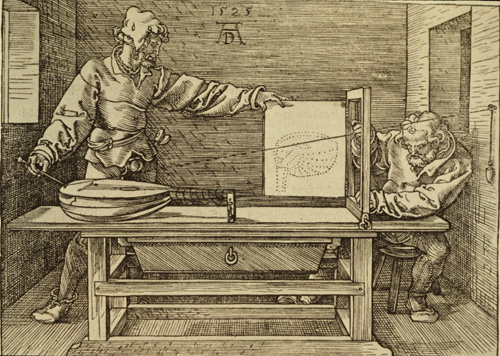
The Mind’s Eye

[Drawing by Albrecht Dürer]
It used to be that architects employed a vision, a set of construction drawings, and a few key perspective renderings to enroll a client in a project. The client had much less information to review when it came time to approve the design – even the perspective renderings were just artistic interpretations in times past. Subsequently the notion of trusting the mind’s eye must have played a more prominent role in the process. There may have been material reviews and possibly even models of important components but the client must have had an extraordinary level of trust in what the architect was envisioning.
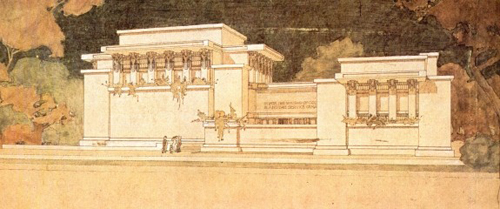
[Perspective drawing of Unity Temple by Frank Lloyd Wright]
Modern technology has advanced far enough to allow the production of photo-realistic renderings, showing how a project will look inside and out, in daylight and at night, allowing an accurate forecast of how the sun will cast shadows on the materials of a building any place on earth at any time on any day. The programs that allow this peak into the future are ubiquitous and inexpensive to the point of even being free in some cases.
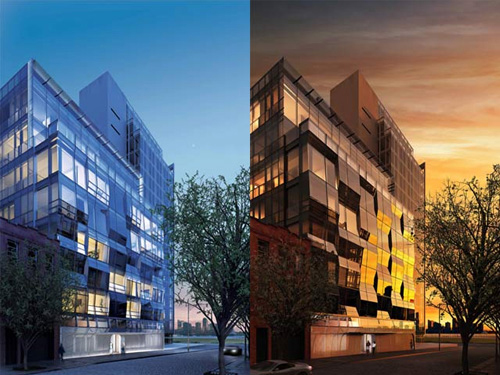
[Perry Street Rendering by Asymptote Architecture]
With these technological advances comes a new paradigm and a new set of expectations. In our current time it’s not unusual to model up a project with photo-realistic materials and render it in photo-realistic conditions, even if it’s just a house. As a side effect, it would seem that the element of trust in the mind’s eye, that existed in the past, has been substituted with prediction and the requirement of a known result.
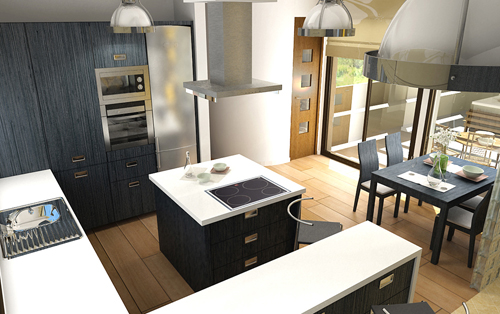
[Interior rendering by Plusig]
We’re not suggesting that this shift is good or bad; simply that the shift exists. That this change has taken place is worth acknowledging because it brings about important questions regarding the nature of design and how architects will operate in the future. In the past were architects taking advantage of blind faith? In the past were architects better skilled at envisioning a finished work in their head? Were architects better with their words and dialogue in the past, thereby relying less on visual representation? Did digital modeling fill a communication void that architects have neglected? Are photo-realistic options explored on a project simply because we can now? Are architects losing the power of the mind’s eye because of digital technology?
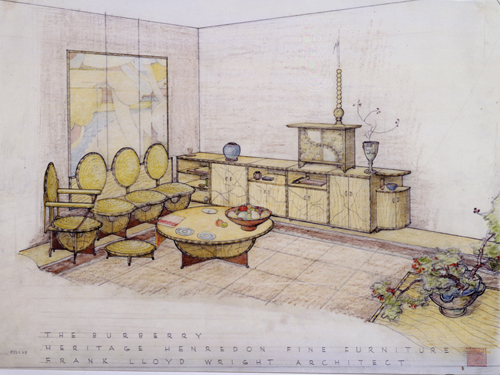
[Interior drawing by Frank Lloyd Wright]
We’re certainly no luddites but we often admire the mind’s eye because it offers qualities that technology can never fully digitize. When architecture is successful there is mystery to it, there is an element of pleasant surprise in the finished product. And while it can’t be drawn, rendered or mocked up, these qualities can be constructed in the mind’s eye. Relying entirely on the predictability of photo-realistic digital modeling seems to ultimately limit the mastery of design. This isn’t to say that the merits of photo-realism should be benched, we’re simply wondering if a more powerful balance exists between digital modeling and a renewed trust in the mind’s eye. One shouldn’t replace the other.
We’re very interested in your thoughts…


By Richter, December 30, 2009 @ 10:43 am
A quick Google image search on ‘architectural rendering’ says quite a bit about the discussion. What comes up as the most photo-realistic renderings are typically very poor projects from a design standpoint; mini-malls, spec houses, and crappy shopping centers. The projects best represented rendering-wise seem to lack the most architecturally. It would seem that the accuracy of rendering is attempting to make up for the lack of design.
By archigeek, December 30, 2009 @ 10:54 am
There is also the factor of time which should be considered. These photo-realistic images take ENORMOUS amounts of time to generate and render, which is expensive. Trusting the Mind’s Eye is comparatively inexpensive (depending on who you hire).
By Gus, December 30, 2009 @ 11:13 am
I think the question is this: if the great architects of the past had access to the digital technology of today, would they have used it? I think yes – regardless of what their mind’s eye was dreaming up.
By mike, December 30, 2009 @ 12:07 pm
it’s not an either/or situation…
there are architects crossing between the two, and producing some fantastic work along the way.
specifically, i’m thinking of LTL, TWBTA and ds+r…
http://curbed.com/uploads/2007_10_ups_ltl.jpg
http://www.archidose.org/Blog/tower-TWBT.jpg
as far as representation – i’d rather blow fee on getting the massing, section, thermal dynamics, etc right rather than having a semi-realistic rendering. and if the end result doesn’t match the rendering, you may run into issues with the client.
i think this is a reason so many residential architects present rough sketches for SD packages. also allows the added benefit of looking like you’ve done a lot of work between SD and DD when you present CAD plans.
By Mike D., December 30, 2009 @ 12:44 pm
As a current client of Build, I can say that this issue hits home extremely acutely for me. For all of the great things Build has provided for my project, the lack of photorealistic modeling has been a big sore spot for me (the only real sore spot actually). I knew in advance Build would only be providing rudimentary models and not the sort of photorealistic wow shots depicted above, but I didn’t know — in retrospect — how hamstrung that would make me feel. It definitely does.
As a designer myself, I live my life in Photoshop. When a client asks how something will look, I don’t draw them wireframes. I mock up high-fidelity comps in Photoshop. I do this, a) because I can, and b) because clients are affected on a very real level by how things actually look, as opposed to how you are describing that they should and will look eventually.
To Build’s point above, I almost wonder if it’s the type of thing where you either commit to doing full photorealistic rendering or you do none at all. In my case, it was that middle ground that seemed to cause problems. It was seeing something on screen or paper that was supposed to look realistic but didn’t. Seeing wood that looked orange instead of brown. Seeing grass that looked like astroturf. Etc etc. At least with a drawing, your brain says something like:
“Wow, I have no idea what this is actually going to look like, but the lines sure look nice!”
… instead of:
“Wow, if the _____ actually comes out looking anything close to what it looks like in this rendering, that would really suck.”
So one of the chief problems seems to be that 3D models can do more harm than good if they aren’t great themselves. And when I say “great”, I mean that even “decent” can be a failure.
The second problem, in my opinion, is something you’ve mentioned in a previous post. The absolute explosion of choice when it comes to building materials and methods. If you were building a craftsman home in the 1970s, why would you even need a 3D model? It’s cedar on the outside, oak on the inside, with some standard porcelain sinks, and everything else you’d expect to find on every other house in your neighborhood. Your 3D model was your neighbor’s house!
Now though, the amount of choices involved in building a modern house is dizzying. We used rainscreen cement board paneling for this project. I’ve never been in a house that used rainscreen cement board paneling (to my knowledge at least). We used NanaWalls. Never experienced those either. ProDema paneling. Same. The list goes on an on. I’m really happy with the choices we’ve made together and as the house comes together, they are starting to look really sharp, but it just doesn’t make for an easy “mind’s eye” vision, as you put it. I *can’t* picture it all together until I see it all together and that’s where some great modeling would have helped.
I remember you guys asking me early on how much photorealistic modeling would have been worth to me. I think I said something like $5000. In retrospect, it’s probably more like double.
Like it or not, I feel like we are definitely moving towards a world in which every project is intricately modeling ahead of time. I talked above about material selection, but modeling also helps immensely with things like sun angle and other livability elements like spatial planning. I’m not sure if this sort of thing needs to be a core competency in the architecture studio itself or if we’re going to see more projects farmed out to places like Archiform3D. I mean, look at their packages. They are pretty sweet. For $3400, you get renderings/flythroughs of:
“… all living rooms, kitchen, bedrooms and one bathroom/ensuite. 4 High-resolution renderings are included; the exterior, 3D floor plan and two living room shots.”
I have no idea what sort of value this stuff would have provided me during the process, but I definitely would have paid $3400 to find out. I wonder if it’s the sort of thing you guys should just add to your package as an option. There’s definitely a business risk in doing so as it could end up creating more harm than good, but I think it’s worth trying at least once, for a small project, to see if it adds value to the process.
Thanks for everything so far. Designing and building a great home, on time and on budget, is 100x more important than any particular step along the way — like modeling — so for succeeding at the stuff that really matters in the end, thank you!
By Kertis, December 30, 2009 @ 6:33 pm
Its great to hear comments from a client on this issue. I am pleasantly surprised to hear interest in spending more in the design fees. Shows you must be very happy with the work.
The issues that I have often run into with clients and the seeming reality of 3d renderings comes down to furnishings. Surely anyone who has ever moved knows that a room is completely different empty vs furnished. If I show an unfurnished model to a client, they still aren’t seeing the building as they will experience it. Alternately if I furnish the model, they are all too often distracted by the seating arrangement shown.
The critical thing that I always try to remind clients of is that all of the drawings and models we produce for them to see are REpresentations of the design, not the design itself. The problem of architectural representation will always be troublesome. The medium of communication is always a choice and that choice has impact on how the message is or is not received.
By Samuel, December 30, 2009 @ 9:51 pm
Interesting dialogue so far.
I think we’re moving (have moved?) into a world where poetry is totally striped away for something predictable and banal. In my opinion, fully representing a thing before its a thing, is the death of it.
And you know, many times, the best outcomes (I would even admit this to my own clients), are simply happy accidents driven by a depth of experience.
By Mike D., December 30, 2009 @ 10:09 pm
Kertis: As a percentage of the total cost of the project, an extra $3k-$10k isn’t a whole lot… providing it adds value and leads you to making better decisions with more confidence. The furniture aspect is interesting. I don’t even feel like I’d need furniture in the renderings, but for at least one part of this project, it would have helped us make a better decision sooner (we ended up enlarging the master bedroom during framing).
Samuel: I totally feel you on that, and in my world, the best stuff I produce is almost always the result of happy accidents, but at the same time, the clients at least get to see the accidents before they sign off on them and pay. It’s less “just trust me, the final product will be great” and more “I spent a month putting your project through all sorts of crazy, spontaneous permutations and this is exactly what I’m thinking it should look like… what do you think?” Granted, this is a lot easier when the finished product *is* digital, but still… it’s the way I’m using to working.
By Mark Gerwing, December 31, 2009 @ 9:05 am
I am an enthusiastic user of computer 3D modeling, both for the design process and presentations. We no longer hear a client say, “Oh, I didn’t think it would look quite like that.”
That said, I don’t think you can discount the exponential effect that this kind of visualization has had. Not only has 3D photorealistic modeling increased the expectation that we can “see” everything but we also tend to present the models from a life-like standing position perspective. We are looking at images of images.
I think that your notes about the loss of the use and trust in the “minds eye” are to the point. It is not the imagination of what the project looks like, but rather what the project is, its colors, smells, textures, and sense of bodily occupation of space. I fear that we are increasing believing that a project is what it looks like. Even an animation is a far cry from being in a space and the architect/designer is supposed to be the medium by which a client can get there.
By andrew, December 31, 2009 @ 1:30 pm
It’s nice to see such clear and strong thinking on this subject. Very interesting and important.
The Renaissance era illustration at the beginning of this post raises very important issues. Before the Renaissance, in Western architecture the building process was inextricable from the body of the builder. His interface with the architecture before its completion was in his ability to project his body into the space he created in his imagination.
It’s been mentioned that the image has no haptic or experiential qualities and those qualities are precisely what defines the architecture as an entity in its physical/existential world. The most photorealistic rendering isn’t the architecture, nor could it ever be. Yet it inherently claims to be.
The fascination with the “discovery” of perspective drawing caused designers to remove their body from the image and become preoccupied with what an architecture would “look like.” Designers became fascinated with attempting to accurately approximate that in imagery—ignoring the fact that it is of course impossible. All along non-western art and design remained more grounded in and true to the sensual world—to the haptic aspects that were only recovered in western art and design with the re-discovery that “this is not a pipe.” That in fact, it was an image of a pipe. The Cubists and others began to explore the experience of how an abject “is” rather than what it looks like.
With this in mind, “Realistic 3D” renderings are, of course, neither.
I read the other day that a few decades ago only about 10% of Americans were dissatisfied with how they looked compared to something like 80 or 90% today. We, of course, have images of beauty as a distraction from actual, perceptible, sensual beauty to thank for that.
I feel like I have lots of reasons to be optimistic though. Just one of them: In the last few years I’ve noticed photography take a very interesting turn. The too-clean, too-vibrant photography provided by the high-tech digital camera has run its course. For the good photographers it was always at best a tool among tools. But more and more photographers are emphasizing elements of how their imagery reflects on or dialogues with the physical world, rather than hastily attempting to perpetuate the myth of photographic truth or worse yet propagate a disingenuous hyper-reality.
The problem is never the technology, but the fascination with the technology in and of itself.
Mike D: If you were to ask me, I would say if you felt hamstrung visually, that may just have been to ultimate boon of your physical experience as a dweller in your beautiful new home. Not that Build’s necessarily got it all figured out (if they’re worth their salt they wouldn’t even claim to) but they’re–bare minimum–barking up the right tree.
By Mike D., December 31, 2009 @ 2:48 pm
Yeah, I do think that the ultimate experience in the home is going to shatter the experience of looking at 3D renderings of it, but I also think that’s because we both made several critical adjustments along the way after we were able to “feel” the home for the first time during framing.
Andrew, Kevin, and I have talked a bit privately about an invention which could aid tremendously in space planning and wouldn’t involve the use of 3D photorealistic modeling. Perhaps one day we’ll make it happen, who knows.
By Build LLC, December 31, 2009 @ 3:37 pm
Many good points made – thanks for everyone’s contribution to an important discussion. Digital ability varies widely from firm to firm and to be specific about BUILD – we’ve got our feet more firmly placed in the construction side of the camp (hence BUILD LLC rather than RENDER LLC). On average it makes more sense for us to concern ourselves with the built product rather than realistic images of the future built product. We put our efforts into generating documents that are true working drawings, communicating clearly with the trades, keeping on budget, keeping to a schedule, etc. This isn’t to say that you can’t have all that AND be producing high-end photo-realistic renderings. But in a smaller firm everyone’s got to be a generalist and having a person entirely dedicated to high-end rendering doesn’t necessarily fit into the formula. As mentioned, the profession is shifting and maybe our philosophy will change. Outsourcing the renderings could have potential – although it could just as easily be riddled with challenges of its own. Renderings are incredibly important to some homeowners, not important at all to others – our approach changes from one job to the next. And we’re always learning…
By Lou M., December 31, 2009 @ 6:01 pm
I’m in a similar spot to Mike D. although not a client of Build am in the process of having a house custom designed by an architect. I too, am also in the creative profession and use the digital tools widely adopted by our industry (indesign, photoshop, illusrator, final cut pro, etc.). Maybe I’m old school (is that possible at 35yo?) but the art of architecture was a draw for me in committing dollars to a project of this scope. Architectural models (who doesn’t love them) and hand-drawn renderings are beautiful to me. I think completely photo-realistic renderings of an object not yet built sort of make something custom and unique into a commodity. Again, my take. In an age of technology and instant everything is there something to be said for vision, for the “mind’s eye”? For trusting and letting the architect do what they are trained to do? My two cents.
By Lou M., December 31, 2009 @ 6:07 pm
For reference, http://www.oskaarchitects.com/Projects/1391/Maxon-House
By Olda Zinke, January 1, 2010 @ 1:29 am
“When architecture is successful there is mystery to it, there is an element of pleasant surprise in the finished product.
And while it can’t be drawn, rendered or mocked up, these qualities can be constructed in the mind’s eye.”
A dose of mysticism here?
“It is some fundamental certainty that a noble soul has about itself, something that cannot to be sought, nor found, nor perhaps lost…. The noble soul has reverence for itself.” Nietzsche.
Who’s on first. No that is not Nietzsche that is Abbot and Costello.
The process of designing a house for a client will most benefit from the use of an integrated solid modeling computer design program. Such a program will allow the designer to begin with a conceptual sketch/model, seamlessly progress to a stage where the client feels comfortable about signing a contract and continue until the last details such as placing the wiring and utility routes are resolved thus avoiding/minimizing interferences and omissions before the beginning of any physical work. Should there be a call for a change/s during construction, those can be then first executed virtually while crosschecking for any possible domino effect. Not to worry, such a program will not hinder the “mind’s eye” in the slightest it is only a precise tool and very obedient one at that if mastered. It will however bring transparency to the process, it will show the client what he/she will be getting, the crafts people what they will be building, be instrumental in creating a list of materials and supplies, time estimate and perhaps most importantly it will allow the designer to see what he/she is designing.
To mystery in architecture and to an element of pleasant surprise I am tempted to say – my ass. I won’t though since I am working on my graces.
Happy New Year Olda
By Olda Zinke, January 1, 2010 @ 12:40 pm
note:
I would like to add to my previous contribution if perhaps needlessly that a program I am describing will allow for placing of furniture, accessories and human mannequins throughout the house and its surroundings to give the client and the designer sense of scale and proportions.
Olda
By TDI, January 1, 2010 @ 3:51 pm
@ Olda – I don’t think the issue is whether or not to employ digital modeling. They’ve been clear about using digital modeling to supplement the mind’s eye. The issue is whether or not to go the full distance of photo-realism with the image.
By Mike D., January 1, 2010 @ 4:42 pm
Build said: “We put our efforts into generating documents that are true working drawings, communicating clearly with the trades, keeping on budget, keeping to a schedule, etc.”
I should mention that I found that to be absolutely true in working with Build. When I was going through the process of deciding whether or not to use a G.C., both G.C.s I presented Build’s drawings to said they were the most detailed and complete architectural drawings they had ever seen. They said it as though they were used to receiving drawings that had plenty of ambiguity or unfinished construction details, whereas Build’s left nothing open for interpretation/corner-cutting/screwing-up. So as something said above, it’s not that Build is not into technology or completeness… it’s just the photo-realistic modeling that is not part of their process at this point in time.
By Paul, January 3, 2010 @ 2:16 pm
In the interests of historical accuracy the illustration of Frank Lloyd Wright’s Unity temple must be credited to Marion Mahony Griffin.
By Olda Zinke, January 7, 2010 @ 12:10 am
@ TDI. and anyone willing to enlighten me.
The mind’s eye stands for the ability to visualize.
The creation of a photo realistic drawing requires the ability to visualize.
If the issue is the balance between the mind’s eye and a photo realistic drawing when used as tools of presentation I fail to see an issue here.
The mind’s eye by definition is not a tool of presentation.
Olda
By Josiah, January 7, 2010 @ 8:28 pm
Ok gents, here is a lil something to inspire your “minds eye.” Amazing video done solely with CGI that is architecturally stunning –
http://vimeo.com/7809605?hd=1