

Chicago: Comparison + Opinion

Chicago header
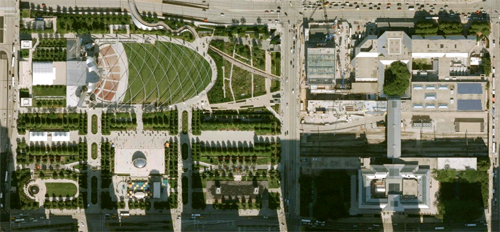
[Photo courtesy Google Earth]

Team BUILD just returned from Chicago where we toured some work that made our heads spin.  Kudos to Chicago for being a city that understands and promotes Architecture with a capital A.  While most of the work was very inspiring, two projects in particular really grabbed us.  They represent extremely different philosophies and ideas in architecture, so for today’s post we thought we’d compare and contrast the two.  We’re going to throw a whole bunch of BUILD opinion into the mix as well, so consume with a huge grain of salt.
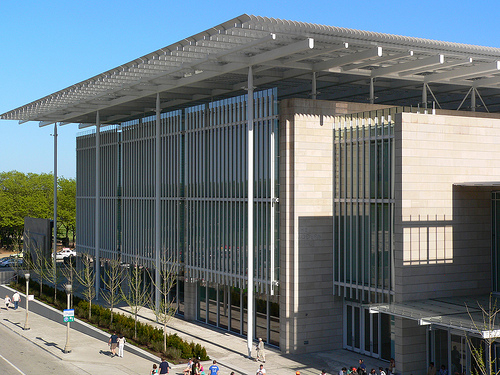
AIoC exterior by pov_steve
[Photo by pov_steve]

The addition at the Art Institute of Chicago by Renzo Piano Building Workshop exemplifies everything that is important to us about architecture and construction.  The experience of the project was inspirational and the visit filled us with optimism about the future of design.  The work got the blood pumping and the gears spinning for several reasons:

1. It’s functional: the circulation is straight-forward, the visuals contain everything that needs to be there and nothing else. The control of daylight has been engineered and used as a subtle design element.
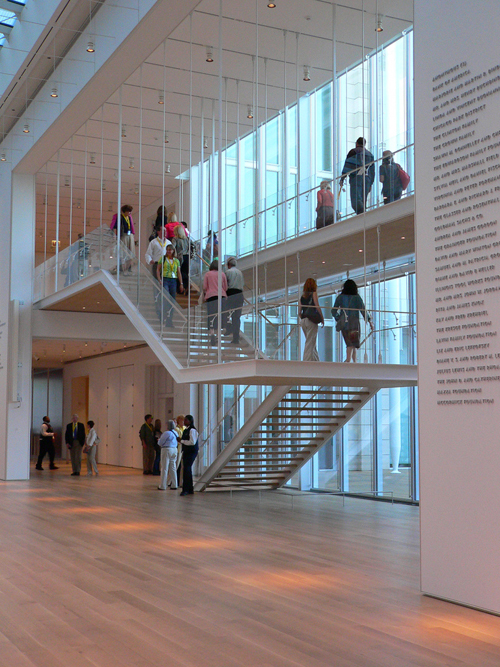
AIoC stair by pov_steve
[Photo by pov_steve]

2. It’s rational: the architecture shows you what it’s doing; it looks like what it is.  Connections between materials are revealed and detailed to look good.

3. It’s well composed: it’s not trying to make some huge design statement.  It is pleasing to look at and the facades become harmonious backdrops to the street life.  At night the glow of the glass walls provide visual warmth and welcomes visitors.  Inside, the building allows the art to be the center of your attention.
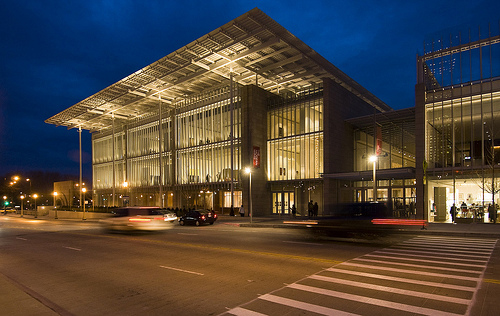
AIoC night by jeklee
[Photo by jeklee]

4. It’s innovative: the lights are integrated with the ceiling trusses, the heating and cooling grills are inconspicuously tucked into reveals that line up with other architectural elements and nearly disappear, the main stairway is attenuated and crisp, the columns and beams are only as big as they need to be to do their job correctly, etc
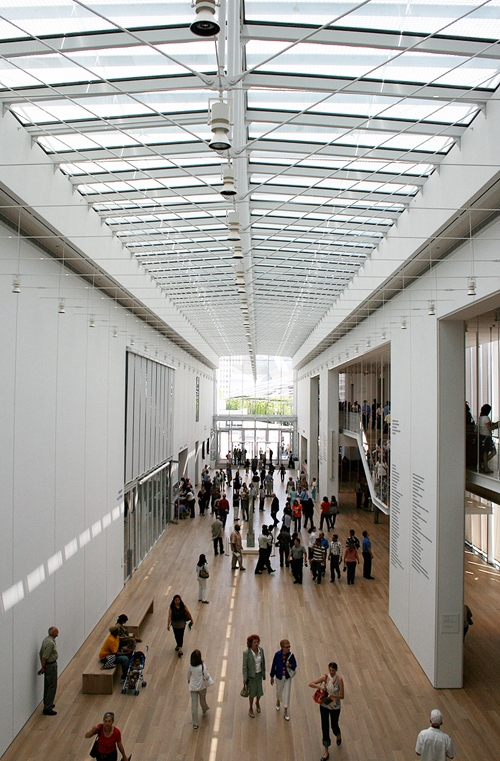
AIoC atrium by sidedown
[Photo by sidedown]

5. It’s warm: we found the wood floors and strategic use of cherry panels to be comforting and calming.

6. It’s interesting: the layers of structure and screening kept us captivated.  The clear communication of structure causes us archi-geeks to think through the structure and assemble the building in our minds.  It is a pleasing building to consider.

Stats:
Total square footage: 264,000
Square footage dedicated to gallery space: 65,000
Construction cost: $300M
Source: Huffington Post
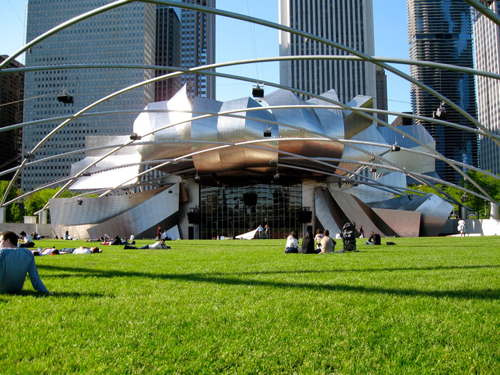
Prizker Pavilion (by Gehry) in Millenium Park
[Photo by mattermatters]

Across the street sits the Pritzker Pavilion designed by Gehry Partners.  As a piece of architecture this work seems to represent much of what is misleading and elusive to us in the design world.  Every time we looked around a corner of the building we scratched our heads and tried to prevent our minds from doing the math (structural-wise, cost-wise, sensibility-wise, etc).  Chicago’s a serious architecture town, a town that has always demanded rigor from its architects and their work.  It seems like Chicago commissioned a Frank Gehry building because everyone else had one and they needed it for their collection.  It seems to us that Chicago could have done without this particular Gehry building for a few reasons:

1. It’s inauthentic: the curved forms seen from the amphitheater area have nothing to do with the actual structure of the building.  Most of what is visible isn’t even the building, it’s just entourage.  It’s hard to tell what the “building” actually looks like.  This would be fine if it were a stage prop – but it’s not, it’s a building.
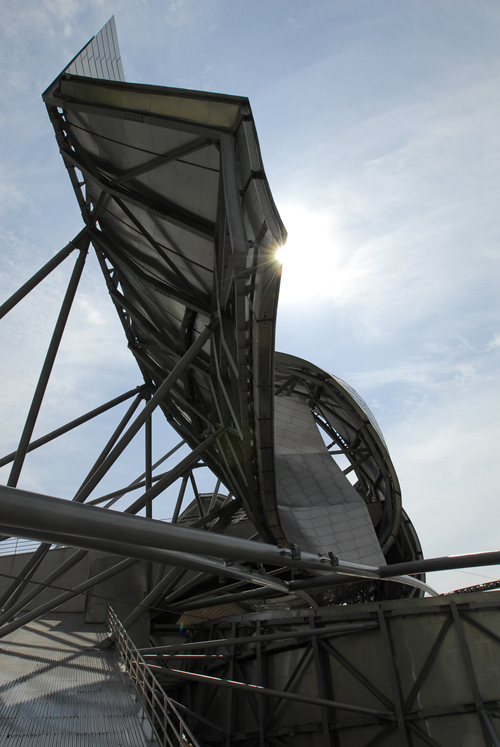
Pritzker Pavilion backside by dutch sheep
[Photo by dutch sheep]

2. It’s irrational: the real structure of the building (behind the curved steel) is a mess.  It doesn’t seem to have any order or rational thought put into it architecturally.  Which is a shame because the team at Gehry Partners probably put an enormous amount of time into the design.

3. It’s playful: while the term has been used to compliment the building’s sense of fun we’re using it to criticize it’s lack of integrity.  Playful is what kids are in a sandbox.  To sideline rationale, sensibility and logic in lieu of playfulness on a 60 million dollar building seems reckless.
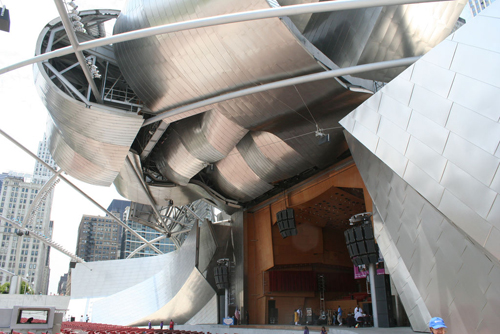
Pritzker Pavilion front by dgphilli
[Photo by dgphilli]

4. It’s unintegrated: it looks as though a big heap of clutter was put on the structural engineers desk to “figure out and make it work” rather than working with the structural engineers and integrating the disciplines.

5. It’s unintelligent: the building doesn’t seem to integrate the various systems together.  It doesn’t seem to maximize the capabilities of materials and form, thereby consuming more resources and time.  It’s clunky.
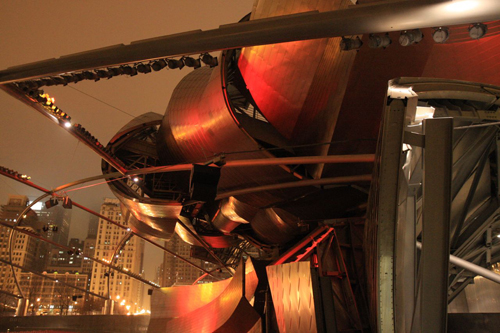
Pritzker Pavilion night by uniblab
[Photo by uniblab]

6. It’s misleading: the project is giving people the impression that the most important ingredient to architecture is an artistic vision – regardless of what’s going on behind the scenes to make it work.

Stats:
Total square footage of amphitheater: 95,000
Square footage of Pritzker Pavilion: not available
Construction cost:  $60M
Source: Wikipedia

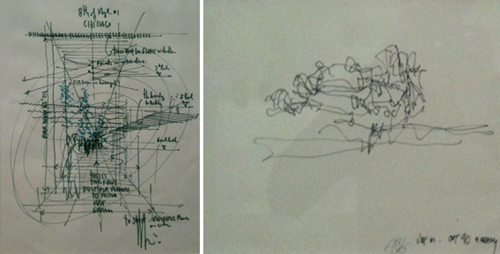
For us the difference between the two buildings is just as clearly illustrated in the initial concept sketches by each Architect.  On the left is Renzo’s sketch for the Art Institute and on the Right is Gehry’s sketch for the Pritzker Pavilion
sketches
[Photos by BUILD LLC]

24 Comments

  • By Lisa, December 7, 2009 @ 5:13 pm

    Couldn’t agree more – Architecturally Chicago should be above the “Gehry Effect”.

  • By Teddy G, December 7, 2009 @ 5:17 pm

    Couldn’t DISAGREE more. The problem with modernism like the new wing at the Art Institute is that you can never tell what it is due to the lack of architectural expression. It could be a museum, an airport or a prison camp for all the viewer knows. I like the Pritzker Pavilion because it looks like an amphitheater.

  • By Gus, December 7, 2009 @ 5:29 pm

    I think of Gehry as an artist who has a team of architects behind him making it all work. The sketches you posted speak to this nicely.

  • By SK, December 7, 2009 @ 5:35 pm

    Whenever I go to Millennium Park for concerts I always have a good time and enjoy the space. I don’t understand why architects have to over-think such issues. Why does it matter if it is misleading or unintegrated? Maybe you guys should just go to a concert there and turn down the technical architect dial for a few hours. Drinks are on me.

  • By Decal, December 7, 2009 @ 9:16 pm

    I don’t have any conflict with the Pritzker Pavilion but I get what you’re saying: is Gehry’s work really something we want to put forth as the future of architecture?

  • By mike, December 7, 2009 @ 9:34 pm

    here’s my beef w/ renzo’s AIC:
    it’s a poorly scaled beyeler. that’s not to say it IS the beyeler, though there are definite themes that i feel are repeated (slipped stone walls, floating roof, play off nature) only at not quite as successfully as the beyeler. the scale of the building seems massive, the intimacy of the beyeler felt just right for viewing a great collection of modern art.

    also, the columns don’t do anything for me.

    that being said, i think it’s several times more successful than gehry’s… thing. and your points on the FOG are dead on. it looks like you’re looking into the ‘flying spaghetti monster’s’ mouth.

    the Lurie Garden (between RPBW & FOG) by local firm GGN, has always been packed when i’ve been there, and same for the lawn with the steel pipe diagrid/dome.

    did you guys take the nichols bridgeway?
    lynn becker had an interesting writeup on it when it was under construction: http://www.lynnbecker.com/repeat/artinstitute/carryingnichols.htm

  • By Richter, December 7, 2009 @ 9:36 pm

    Gehry’s buildings are a formula – he’s not selected for his architecture anymore, he’s selected for the popularity and revenue his creations bring to a city. That being case it doesn’t matter whether it’s considered architecture, art, or stage prop. It’s revenue that’s being commissioned.

  • By Samuel, December 8, 2009 @ 6:51 am

    I haven’t had the chance to see either, but I think your summary is good. Although, with Gehry’s general popularity, I’m sure he is a revenue generator- not sure if its enough to pay for what this stuff must cost, but its got to bring some money to the area.

  • By Brian, December 8, 2009 @ 9:53 am

    I agree with a lot of what is said here. On another note about the Pavillion, I was lucky enough to be in Chicago the day Millennium Park opened, and saw an article that interviewed Gehry about his structure. I can’t believe they printed this either. Gehry went on to say he had a lot of other designs he put forward, that looked nothing like this. The committee always came back saying “this doesn’t look like a Frank Gehry building.” So you are exactly right in saying Chicago just wanted a Gehry building because a lot of other people had one. It seems Gehry doesn’t even want to do “Gehry” buildings anymore.

  • By Snappy, December 8, 2009 @ 2:56 pm

    Thanks for crediting the photographers and linking to their Flickr accounts. As a photographer I really appreciate the attention to detail.

  • By Build LLC, December 8, 2009 @ 3:11 pm

    Great points everyone:

    @ Gus -agreed that Gehry is more of an artist with a team of architects behind him – we just wish those architects would get a bit more credit for making it all work.

    @ SK -we’ll take you up on the drinks.

    @ Mike -we did take the nichols bridgeway and the funny thing was that we actually liked Gehry’s bridge better. Renzo’s bridge (unlike the AIC) seemed clunky and looking down the sightlines it’s not straight. It didn’t reflect the technical accuracy of the museum itself. Maybe Renzo had Frank design it for him – HA!

    @ Richter -agreed, the Gehry stamp of approval is much more than architecture.

    @ Samuel -we attempted to break down costs per square foot for a project comparison but the conditioned area of the Pritzker Pavilion doesn’t seem to be available. It’s hard to determine how they stack up construction cost wise.

    @ Brian -we believe it! Gehry is stuck in his own success.

    @ Snappy -our pleasure, we take a lot of photos and like to receive credit ourselves.

  • By Gary T, December 8, 2009 @ 3:15 pm

    That might make a good blog post: the teams behind the starchitects.

  • By Ashley DeForest, December 8, 2009 @ 6:54 pm

    I agree with your assessment of the two structures.

    I appreciate the Art Institute’s efficient use of space and materials, especially at a time when both are dwindling.

  • By db, December 9, 2009 @ 4:58 pm

    I feel whether we as architects or we as the public like Gerhy’s buildings or not we still need them. There are several reasons for this. First of all it adds a richness or another texture to the built environment. We need odd, unusual and ugly buildings just as we need the beautiful and elegant ones. The built environment needs a dialogue. Another reason we need “Gehry’s” is that it allows us to understand what we a capable of. A Gehry product may not be the desirable product for everyone but, it is a stepping stone and it can inspire and suggest ideas for future progression. It may also allow us to better understand new building methods and technologies.

  • By Lee, December 11, 2009 @ 3:20 pm

    I think you totally missed the mark with your assessment of the Pritzker Pavilion. I don’t really like Gehry’s buildings, but I do really like the Pritzker Pavilion, and I think that’s because it’s not a building, though you’ve mistaken it for one. It’s a bandshell, and so it is essentially a stage prop. It builds on our cultural history with the older Petrillo bandshell across the street. An actual building couldn’t have been built in this part of Grant Park — it’s not allowed (remember “forever free and clear lakefront”). I think you miss the mark in assuming the design should articulate and define the structure, as if it were a building. For a bandshell like this, I think the design should define and articulate the space where the audience is sitting outdoors. And it succeeds well at that. The trellis also gives the space an incredible sense of enclosure and offers a new perspective on the surrounding skyline. Gehry does well at flourishes, and while I don’t think fanciful flourishes are appropriate for urban buildings where they often degrade function, they are appropriate in a park setting on a sculptural bandshell where art is the primary focus of the experience.

  • By Lee, December 11, 2009 @ 3:24 pm

    PS – Gehry’s bridge is the perfect example of all functionality being sacrificed for flourish. It’s a shame he didn’t just stick to the bandshell. That bridge drives me nuts.

  • By Build LLC, December 11, 2009 @ 3:47 pm

    @ Lee – you bring up an important issue – how is the Pritzker Pavilion to be evaluated? If it’s just as a band-shell the critique is, indeed, a different ballgame. We’re running off the assumption (maybe incorrectly) that it has conditioned area, has an envelope (needs to keep the rain out and the heat in), and maybe even has habitable space below the ground level. Difficult to say – there’s so little technical information out there about the Pavilion.

  • By Krista, December 12, 2009 @ 1:41 pm

    Pritzker Pavilion is aligned with Washington Street in the business district, and it looks amazing from that vantage point on the west. It enhances the urban environment for us shmoes on a daily basis.

    Also, I endorse Lee’s assessment that it is a bandshell, and agree with sk that it is a special venue for concerts. For example, I saw Wilco perform at Pritzker, and earlier at the Petrillo Bandshell (which the Pritzker has largely supplanted), and the new place is *magical*.

  • By west town ed, December 12, 2009 @ 2:21 pm

    For those interested in the history of Millennium Park, I recommend “Millennium Park: Creating a Chicago Landmark” by Timothy J. Gilfoyle in association with the Chicago History Museum, published by the University of Chicago Press. After reading it you will know the background of such features as the Pritzker Pavilion and also why the park was several years late and greatly over budget.

    It is said that Penny Pritzker made Daley an offer he couldn’t refuse, if Gehry gets to design it, we’ll pay for it. And they did…

    The back stage areas of the pavilion are shared with the Harris Theater for Music and Dance and, yes, the open stage area can be sealed off by huge glass and wood doors. This is not much good for concerts but great for a winter fundraisers.

    As for its design, isn’t it one of the more perfect examples of Robert Venturi’s decorated shed?

  • By KidA, December 14, 2009 @ 1:22 pm

    I like your assessment of both projects and I think time will be the ultimate test of which is a better form of “architecture”. In ten years from now it will be very clear.

  • By TDI, December 14, 2009 @ 1:28 pm

    um what?…. do some of you really think the Pritzker is merely a bandshell and not a building? Really? A 60 Million dollar… bandshell. Really. Stop drinking the Kool-Aid, take a step back and re-evaluate it will ya. This isn’t a stage prop at your kid’s talent show, it’s a $60M structure and it has responsibilities and consequences far beyond a mere bandshell.

  • By Lachance, December 17, 2009 @ 1:49 pm

    I haven’t seen the Gehry building in Chicago myself but everything your describing applies to his work on the Experience Music Project in Seattle. His firm seems to be very hit or miss.

Other Links to this Post

  1. Midwest Miscellany | Michigan Real Estate — December 12, 2009 @ 5:09 am

  2. The Urbanophile » Blog Archive » Midwest Miscellany — January 30, 2012 @ 5:48 pm

Leave a comment