

Raising the Bar

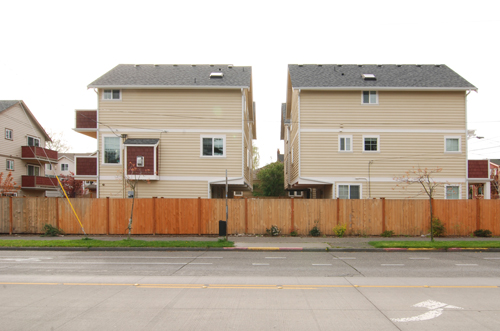
4-pack-townhomes-01

Recently BUILD attended a meeting at the American Institute of Architects intended to improve the neighborhoods of Seattle. A group of knowledgeable, experienced architects is currently leading the charge and the discussion is aimed directly at the recent wave of developer townhomes (also referred to as 4-packs because of their identical cookie-cutter designs plunked down all over town). The group of architects is proposing several building code changes to the City Council which would encourage things like front doors that face the street, better facades, and more landscaping around parking areas. Some of these proposed code changes would also discourage the interior parking courts often associated with these townhomes.

And that’s great. Kudos to the hard working professionals who are taking action on what we all know to be a monumental urban problem. But here’s the BUILD take: no matter how carefully the building code is constructed, the schlock developers will figure out a way to boil down the townhouse to its most lucrative and expeditious form – at the cost of aesthetics and good urban design.

On the flip side of the coin – no matter how ridiculous the building codes, good architects will figure out a way to create beautiful, cost effective dwellings. The building code in-and-of itself will not determine the quality of our built environment. We are foolish to think that we can correct the current urban blight by adjusting the building codes and ignoring the larger issues of how we, as a society, behave and think.
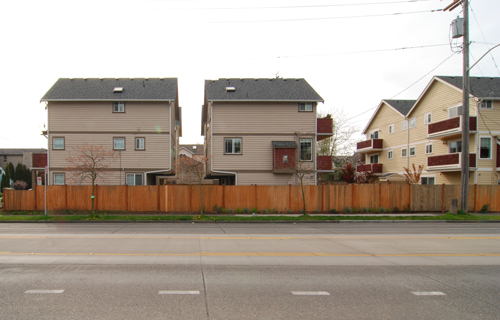
4-pack-townhomes-02

Ultimately, all good architects are interested in urban development and commitment to sustainable design. And we’re no different; however we’ve got some different recommendations to turn this ship around:

1. Raise the level of public awareness and acceptance. Why do we, as a society, put up with these garbage townhouse models? In places like Scandinavia the 4-pack townhouse model simply wouldn’t fly – not because they don’t meet the building code but because the public wouldn’t tolerate them as a solution to housing. It is our job as architects to be communicating to, sharing with, and educating the public so that the cross section of our culture sets a higher standard of housing. We’re starting today with our “Raising the Bar” series which you’ll see in our category list on the left. We’ll do our best to update it with relevant issues and get it out there.

2. The Building Department needs to work with architects as problem solvers. The planners and reviewers at the building department are team members on any project just like the structural engineer and the electrician. Unfortunately when it comes to reviewing a project, the 4-pack townhouse model is actually rewarded because it is a familiar formula. The review is simpler and takes less time than a similar project of more innovation and architectural quality. Doing good architecture is often penalized at the building department simply because it is unfamiliar. If we are to improve our built environment it is imperative for individuals at the building department to be team players.

3. Vet out the developers and architects doing this sort of cookie-cutter 4-pack work. What is the point of having an architectural licensing process if licensure cannot be scrutinized or even revoked for doing work that is harmful to our built environment?

Accept, decline or counter-offer… but don’t be shy with the comments button.

12 Comments

  • By Richter, April 21, 2009 @ 12:00 pm

    There was a good article in the DJC from April 15th which adds to this discussion:
    http://www.djc.com/news/ae/12005041.html

    It notes the community review process which I also think is an important ingredient to good design.

  • By mike, April 21, 2009 @ 6:08 pm

    these are some of the thoughts/issues i see w/ the ungodly 4-pack and current codes in the city:

    -because land is scarce in seattle (in prime areas, anyway) developers have to cut back to keep their profit margins through the roof. hiring architects and specifying not-so-sh*tty products would push the cost of the housing up, which would deflate the developers profit margins (or so their illogical thinking goes). liz dunn, fremont lofts, nicholas court and numerous other projects around town (park modern anyone?) notwithstanding.

    -i’m hoping that code changes don’t mandate too much (door facing street and interior parking court aren’t always bad) there are ways around this (increased glazing, or a street-oriented facade, but don’t tell me where to put the door. if you want south kensington, allow developers to (actually) put up rowhouses.

    -i’m actually for upzoning in some SF zones. if a developer can gather several sites, it’d be nice to put up a decent multi-family project that blends in w/out being the typical boxy abortion
    (reference this post: http://blog.buildllc.com/2008/10/models-for-low-rise-multi-family-housing-europe/)

    -would it be too much of a hassle to have DPD actually throw some modern designs into their fliers? i think by only showing craftsman reduxes, they’re actually promoting blechy craftsman reduxes.

    -from your perspective, does part of the problem stem from pols getting their wheels greased by developers and not architects?

    as for what can be done about the 4 pack…
    i’m all for shaming the developers and increasing public awareness of what is possible. a lot of new homeowners are priced out of the nicer places, and so the 4-pack and apartment-cum-condo are the only way to break into the market.

    the b9 project referenced in Richter’s DJC article and the secret garden development by madrona co. @ 11th and thomas on capitol hill provide nice alternatives (though i wouldn’t buy either)… both also have more than 8 units.

  • By Knudsen, April 21, 2009 @ 8:53 pm

    I’ve always been an advocate of fewer rules and more responsible people. It seems like this could benefit the situation you describe.

  • By lou m, April 21, 2009 @ 9:41 pm

    Perhaps the ugly truth of all this is that you have to have tons of cash in order to beat these uncreative developers and fellow architects to the punch. Having lived in one of these four-packs early on in my house owning experience I can tell you that it’s not something I’m proud of but sometimes folks do have to start somewhere and these four-packs are usually the gateway home for many 1st time buyers. Perhaps the solution is to push the city and creative incentives, credits, etc. for architects and worthy developers to build out this architectural utopia.

  • By chris, April 21, 2009 @ 9:54 pm

    How can the design profession convince the typical for profit developer to build good contributing structures in an existing neighborhood?

    I say, downzoning…

    OK, now for the explanation

    There is a need for a mechanism to convince (force) the developer to create good (hopefully great) Architecture

    Simplistic rules that define setbacks, height limits, size limits, etc don’t produce Architecture, they produce boxes.

    An idea I’ve been kicking around would be an incentive for the developer to hire an Architect…

    Here are my thoughts… the city would attempt to prevent the 4-pack or other zoning code maximizers by actually downzoning… yes downzoning. By upzoning the city has created an opportunity for developers to build out to the zoning maximums and thus create large boxes with abandon. In the case of the 4-packs… 4 large boxes.

    By downzoning and limiting the “as of right” FAR and unit counts, the city could then allow and control bonuses for additional FAR, units or anything that is found to be lacking in a particular area of the city. In my opinion some of those bonuses or trade offs could be as follows…

    Using the 4-pack as an example…

    First, the developer would be allowed to build 2 units on the newly downzoned property “as of right”, then as a “bonus” the developer could build an additional unit and more FAR by simply hiring a licensed Architect. Additional bonuses, like a fourth unit, could be allowed if the developer agrees to a “design review”…

    The developer now has to present to a board of design professionals, to review the design… the existing elected or appointed Design Review boards are nice political facades that make the public feel warm and fuzzy, but they have their own dogma and lack of power. IMHO

    A board of professionals has much more to lose by allowing bad designs and non contributing buildings to be built than any current Design Review Board. Review boards were an attempt to create a better built environment, but we as design professionals should be policing our own. I have never been able to understand how a two design professionals, a local business person and a person from the neighborhood can, as a group provide any oversight for the built environment. Yes they can hold a public meeting, discuss some of the atrocious details and possibly prevent utter nonsense from getting built, but they are usually over taxed and don’t contribute forward thinking design cues or feedback for the built environment.

    Design professionals on the other hand don’t usually like to be reviewed by anyone, let alone a peer… but providing good design today is usually a team effort. Adding in a third party could be the “kick” that is needed to get things back on track.

    This simple tiered system could be applied in many different ways, levels and instances to “encourage” the developers to provide good Architecture.

    Let the design professionals do their job and design the built environment!

    Downzoning…

    enough egotistical ranting for the evening…

  • By Anonymous, April 22, 2009 @ 8:17 am

    I’d like to see Architects form a stronger political position in the US. Although I’m not a big proponent of unions in general, in other countries such as Denmark, the Architects are one of the strongest unions and are able to demand that “everything” be designed well. How can architects in the US begin to generate this type of influence? I’d like our state to take the lead in requiring that all projects be designed by a licensed architect. Although this wouldn’t eliminate all the “hacks” out there, but it would be a good start and would increase business for architects. Just a thought.

  • By oberon, April 22, 2009 @ 1:45 pm

    I own a crappy 4-pack townhouse. I bought it because it was the only affordable and easy-to-maintain option in the neighborhood that allows me to walk to work. They’re building non-crappy, built-green townhouses down the street (http://in-fremont.com), but the listed price per square foot is almost 50% higher than mine.

    I hope that developments in building technologies (e.g., SIPS) will start to allow good design at lower prices, but we’re not there yet.

  • By js, April 22, 2009 @ 3:25 pm

    Please not more rules!!!(some times the rules(design committees) force building this c—) Instead I think One’s architectural license should be up for review every 5 years. You need to present all of your projects, and if they are not up to par(like the 4 packs) you loose you license. The other thing i would love to see is a License needed for developers, that would make my day.

  • By andrew, April 22, 2009 @ 9:10 pm

    Today a professor I respect told me we need to “identify the lack of difference between the box tissue and toilet paper.” We never use the one in place of the because that’s the way it’s handed to us not because the two tissues are so carefully specialized for their tasks. We buy crap in our economic model because it is familiar, cheap and available.

    Architects have to take it upon themselves to identify for people/communities how they could be living better and be prepared to provide that at a rate people can live with.

    Modern architecture the likes of Eames, Schindler, Cutler, Dan Rockhill, Etc, aren’t better because of stylistic loyalties, they’re better because they respond to specifics of people and place.

    That doesn’t have to be overly expensive.

    As soon as architects can beat developers at their own game (and, I’ll just throw in–change the rules so it’s a more life affirming game) well-designed communities will win out. Meanwhile wealthy people will continue to live well and the rest of us will get by in four packs and tract homes not knowing our lives could be richer and more connected to each other and our places.

    Rules aren’t the answer, specifics in problem solving and providing viable alternatives is.

  • By KP, April 25, 2009 @ 2:28 pm

    I have two issues relating to the economics of this discussion.

    One is that good design costs money. For someone with talent to spend their time working on a project they have to be paid – enough that they won’t spend that time doing something else. Unless you find a guild of altruistic architects who do their work for free, someone has to pay – either the homeowner who buys the new home, or the taxpayer if this is subsidized, or the owner of the land before the new home is constructed.

    This second issue is one I don’t often hear discussed. The former homeowner in a neighborhood undergoing these changes seems to have the least to say about things and may not even be aware how building codes affect their property values. Think of the older people in a neighborhood who will be hurt if zoning rule changes reduce the price that developers are willing to pay to buy their old home and lot; they may not have another significant source of wealth to pay for assisted living they may need in their later years. This is effectively confiscating part of their wealth in order to advance someone else’s idea of better taste.

    We can force this issue through laws and codes, but you are just shifting the economics around from one party to another. These kinds of changes won’t happen for free.

  • By mike, April 25, 2009 @ 3:21 pm

    “This is effectively confiscating part of their wealth in order to advance someone else’s idea of better taste.”

    only this isn’t true. when the land was upzoned around the denny triangle, lot values tripled. upzoning doesn’t make land less valuable, it does the opposite, generally. unless it’s done in places that don’t make sense.

  • By Joshua Daniel Franklin, May 8, 2009 @ 7:53 am

    I see this post is a little stale, but the same thing recently came up Lowrise discussion at hugeasscity. A very interesting survey done for Williams Marketing (yes, the townhome people) had this question: “What do they want to buy?” 29.8% Urban Condominium, 20.8% Highrise Condominium, 20.0% Single Family Residence, 13.5%
    Townhome. The biggest location priority (70.2%) is a walkable neighborhood. “Society” wants higher quality and I think townhome developers are actually the ones behind the curve. So far I’ve heard 3 separate townhome dwellers say they were outbid on available condos and so settled on townhomes. The worst part is that condos don’t even cost more (as the Park Modern demonstrates), there just aren’t enough of them.

Other Links to this Post

Leave a comment