
Raising the Bar #3: Well Executed Townhomes
Our “Raising the Bar” series is a means to communicate directly with the community about the architecture we experience on a daily basis. As a theme, it examines the lack of good design in our built environment and highlights exemplary projects that are leading the way to a healthier, more inspiring society. We’ve been talking to our friends and colleagues lately about the state of townhomes in Seattle, and for today’s post we’re highlighting three well-executed examples of modern, urban living. These projects were selected not only because of the gorgeous finished products, but also because of the design teams involved. Behind each of these projects is a team of architects dedicated to doing good work, developers who are concerned with the built environment and banks willing to invest in the quality of life here in the northwest. Our martini glasses are raised to all of you – cheers and congratulations on some very intelligent projects.
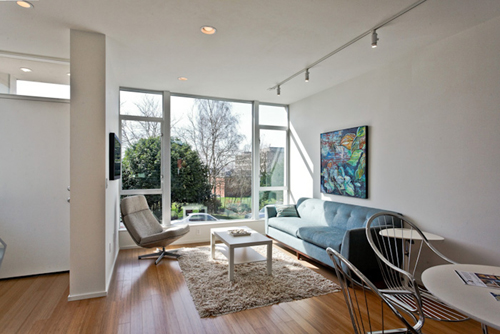
EAST LAKE UNION LOFTS 2350 Minor Avenue East
Designed by Carsten Stinn Architecture, the project includes 6 town-homes very well located in Seattle’s East Lake neighborhood.
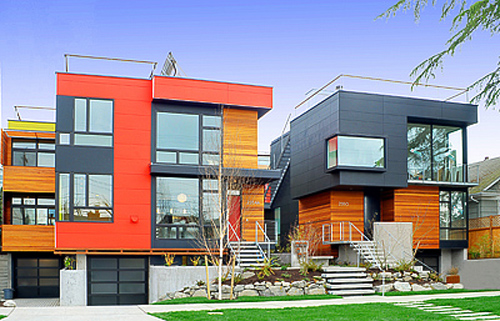
“These homes have been designed to merge modern architecture and cutting edge green construction, ultimately providing a home that is not only environmentally sound, but also visually stunning.”
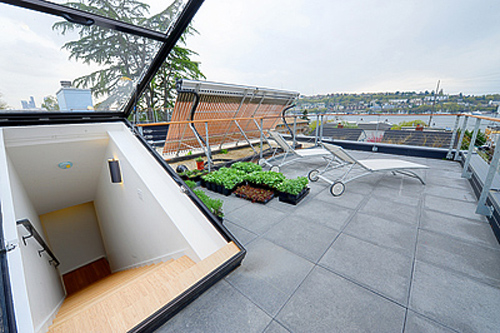
“This project is a new unique interpretation of dwelling within city limits. We have abandoned the current model of ‘profitability-by-cheap-formula’ in order to support the ‘community model’. The concept for the project was conceived out of the conviction that multi-family sites can be developed in a fresh new way and set itself apart from cookie-cutter development that we see all over Seattle.”

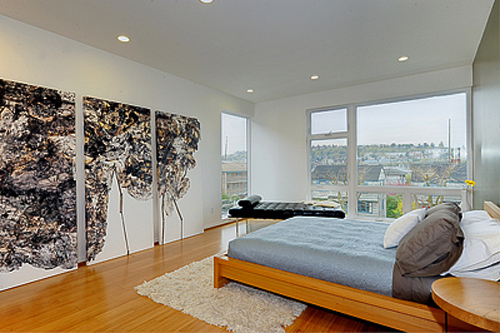

Homes at the Lake Union Lofts are currently on the market and the managing broker, Jon Hunter, can be reached at 206.228.1974.
URBAN CANYON 1526 19th Avenue
Designed by b9architects, the project includes 7 town-homes situated within walking distance of all the action on Capitol Hill.
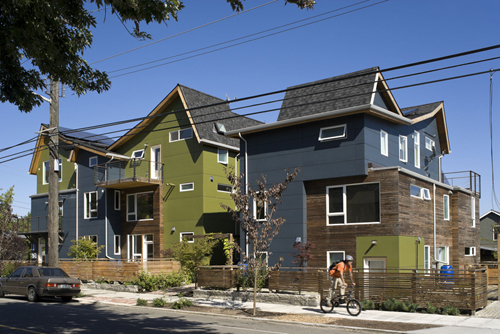
“This design is about a canyon; a place for people to walk, hang out, and visit with a neighbor; a place to be community.”
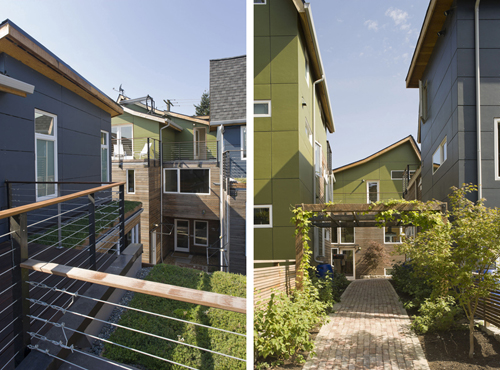
Cars are discreetly tucked away under a trellis at the edge of the site so that neighbors have a chance to interact in an informal setting.
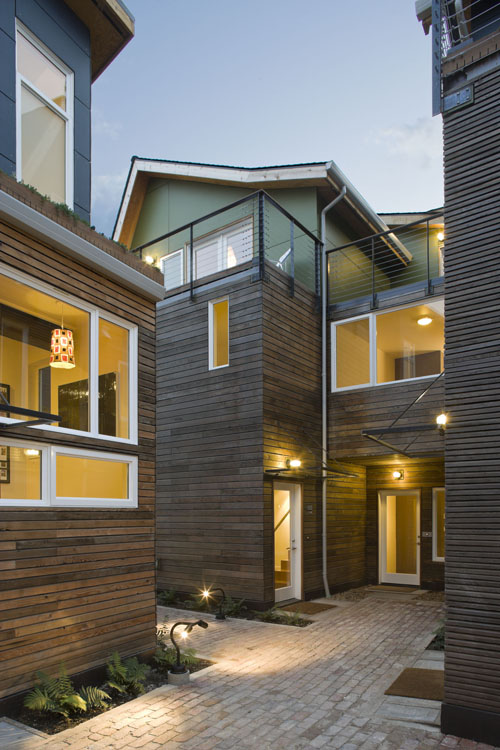
“The canyon’s orientation allows for southern light and air to reach all of the units and penetrate the site. Entries are accessed from the pedestrian canyon. The massing allows roof decks with views back into the canyon and to the Cascade Mountains to the east for all homes.”
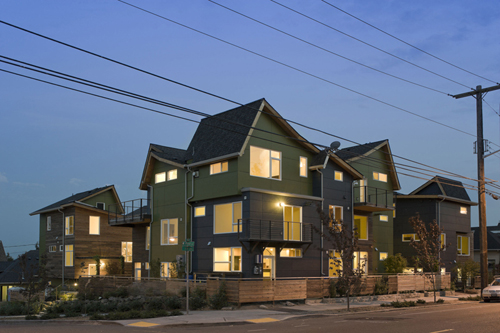
The project is entirely sold out with one available resale currently on the market. The realtor, Todd Hagan, can be reached at 206.448.6400.
REMINGTON COURT 1320 East Remington Court
Designed by Hybrid Seattle, the project includes 3 town-homes located on 1st Hill.
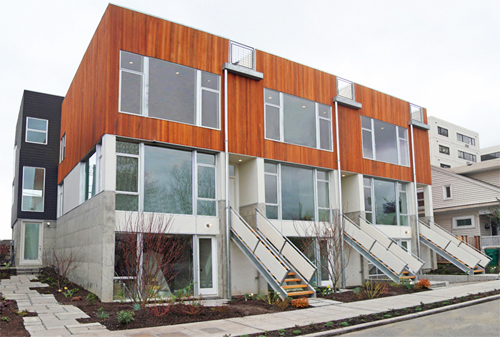
“Remington Court Urban Dwelling is a progressive Seattle modern home development. Sophisticated in design and complimentary to the progressive needs of urban sustainability.”
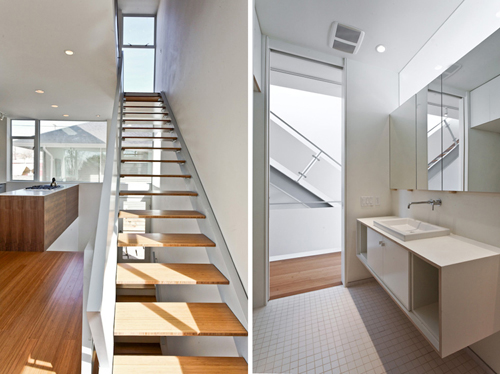
The project gives a 360 degree view of the neighborhood on the vegetated roof top deck. The roof top deck is equipped with 8″ of soil allowing home owners the opportunity to experience roof top gardening.
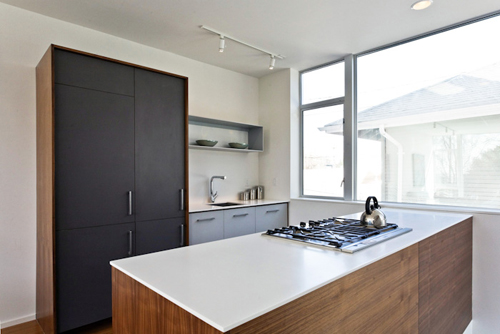
The architects are hosting a release party on Friday, May 1st from 5pm to Midnight, check out the invite here. The event will host live music my Seattle’s very own Spoonman.

Homes at Remington Court are currently on the market and the managing broker, Dararith Marith can be reached at 206.322.8711
21 Comments
Other Links to this Post
-
Shared Items - May 1, 2009 | Polycentrism — April 30, 2009 @ 11:12 pm


By brian, April 30, 2009 @ 12:47 pm
Those are certainly nice, but how does “raising the bar” not just equate to “spend more money”? Even disregarding $/sqft, how about examples of something that can retail at the same levels as the 4-packs you so dislike.
By Brendan, April 30, 2009 @ 1:13 pm
Wow, these are gorgeous! Thanks for posting these examples. However, I do agree with Brian, I think the design argument is not effective without showing comparables on a constant-cost basis. It’s the biggest criticism of homes like these from the general public, even those who agree the design is much better. Being involved with the design of my own home right now (with my brother, an architect at SOM in Manhattan, the designer) I know the features in the homes above would cost a mint compared to the bland townhomes you showed in a previous post.
By John, April 30, 2009 @ 4:18 pm
Nice projects all around – however if we look beyond our own borders there are also several great examples from Portland that we could discuss. One in particular that I like is the Williams Five Condos (http://www.williamsfivecondos.com) that were featured on the recent 11x Design Tour (11+ Portland area projects designed and developed by architects). The building was both well-sited and well designed, and not outrageously priced.
To further the gospel on good townhome design Seattle should host our own design tour – what do you think?
-John
By mike, May 1, 2009 @ 8:11 pm
i’m going to go out on a limb here and state if you want affordable housing, especially in seattle, it’s not going to be single family homes, 4-packs, 6 packs or small townhomes.
it’ll be low-mid rise. and that’s not a bad thing, especially if it’s done right.
maybe the city could initiate something innovative modeled off of the quartier vauban in freiburg.
-car free living
-streets designed for people (2 solar garages house cars for the few residents that want them)
-access to multiple modes of transport
-high density
-mixed income
-retail core for short trips
-green buildings (passivhaus!!) w/ renewable energy on site
oh vauban, how i miss ye…
http://www.vauban.de/
By KP, May 3, 2009 @ 9:08 am
I love the design of these over the 4-packs, but would echo Brian’s question. How does the construction/design cost and market price of “good design” compare to “bad design”? Without this information we may just be comparing “expensive” to “cheap.” Don’t get me wrong, I think there’s value in good design, but I think there’s also a cost to it… but please, prove me wrong.
By Nick Williams, May 3, 2009 @ 10:37 am
We built remington court @ $165/sf. If you are cost conscious and compare design alternatives (ie: your design and specs are not set in stone when you begin construction) aka material A vs. material B; labor A vs. labor B…then you can build for a lower $/sf. You can then pass the savings along to your buyers and your units do not sit on the market for too long. Good design can be affordable if developers are not as spendhappy and profit-driven.
I think if architects are more involved with budgeting/estimating from the conception of the project; and paid fairly to do construction administration, buildings can be built more affordably without compromising good design.
By Build LLC, May 4, 2009 @ 2:16 pm
All good points. The question that keeps coming up is what constitutes “Raising the Bar” from just spending more money? Admittedly, the purchase price of what we consider to be “good design” is typically higher than the 4-pack model – but, we’ve found the additional costs are truly marginal. Keep in mind, the better versions still use wood framing, similar quality of finishes, similar types/ scale of property, etc. They are just assembled in a manner that isn’t embarrasing. There is an additional cost for the (slightly more) custom design approach, but at the end of the day, this too is marginal. We’ve looked at sales values for the better version and they are relatively similar in cost costs as the 4-pack.
Here are some additional factors to consider:
1. Durability of materials: The 4-pack townhouse models tend to use materials that mimic traditional materials and do so poorly: vinyl windows that try and look like painted wood windows and cement board panels that have fake wood grain. There are many modern materials that trade in the illusion of traditional appearance for better performance over time (for the same price). Aluminum windows are very durable, maintenance free and are similar in cost to vinyl.
2. Lifecycle: So far the questions have only been raised in terms of initial purchase price. We propose that these 4-pack homes should be thought of as disposable housing. Based on what we’ve seen – these structures won’t make it 50 years (30 may be the median age) – not just from a perceived obsolescence but also from a designed obsolescence. While better quality construction may need updates in a few decades, the 4-packs will need to be torn down entirely. Life-cycle costs need to be incorporated in this dialogue, not just purchase price or cost per square foot. While the individual homeowner may only be concerned with a homes initial cost comparison and appreciation within a several year period – the Raising the Bar theme attempts to evaluate these housing types over a time span that at least looks at a decade (dare we say, several generations). A standing seam metal roof only appears expensive as an initial cost. Compare that same roof to composite shingles over time, and it’s a different story entirely.
3. Commitment: Tough to measure, but worth sticking our necks out for it. We think that the 4-pack model has become a stepping stone in Seattle. It seems to be the intermediate for people who are moving out of rentals and can’t yet afford a house. There is a relationship between the transient nature of this housing type and the lack of taking care of it. We don’t tend to see this in the examples of higher quality – people buy them because they want to live there and they want to take good care of it. Again, we offer that “raising the bar” while only marginally raising the costs, will ultimately lead this housing type to be less transient and more cared for.
4. Localization: 4-packs are based on only a couple of different designs. They are plunked down all over town in the same orientation, rarely with any consideration to the local factors like view, sunlight, shade, trees, etc. Organizing the design to take full advantage of local and regional elements doesn’t have to cost more than the cookie cutter models, yet it creates a measurable difference in the quality of the living spaces. It raises the bar.
5. Overdesign: 4-packs are typically overdesigned to appeal to a more traditional design sensibility. All of the funny little gables roofs and knee braces at the eaves are typically unnecessary and cost more than just doing a simple shed roof. For reasons we have never understood, the 4-packs often include space-destroying features like 45 degree angled walls inside. Costs would be saved simply by cleaning this cookie-cutter up in the design stage.
We’ll attempt to provide some examples and costs on the next “Raising the Bar” post. Stay tuned and thanks for the comments…
By mike, May 4, 2009 @ 2:52 pm
Ironically, I was sent this today:
Public Meeting on Administrative Design Review for Townhouses
Bertha Knight Landes Room
Seattle City Hall
600 4th Avenue
Doors open @ 5.30
http://www.seattle.gov/dpd/news/20090428a.asp
By oberon, May 6, 2009 @ 8:42 pm
These are fair points, and beautiful homes, but it’s worth pointing out that the first two out of these three examples are not just “marginally” more expensive. The two MLS-listed East Lake townhouses are priced at $890k and $980k, and the gProjects resale at $985k. Even if someone was willing to commit to a better-designed, longer-lasting townhome, they’d have to make $200k+ a year just to qualify for the loan. The Remington Court units are the exception; kudos to them. We need more of that kind of innovation.
By oberon, May 6, 2009 @ 8:45 pm
Sorry, I transposed two numbers; I should have said that the resale was $895k.
By Build LLC, May 7, 2009 @ 7:50 am
Oberon – True, given the direction that the discussion has taken we’ll be bringing in some additional examples into the fold.
By mike, May 12, 2009 @ 10:39 pm
vaubanin the nyt!
http://www.nytimes.com/2009/05/12/science/earth/12suburb.html
By Build LLC, May 13, 2009 @ 7:32 am
Mike – wow, nearly 4,000 of Vaubanin’s 5,000 inhabitants do not own cars, impressive. Good article.
By Joshua Daniel Franklin, May 13, 2009 @ 12:51 pm
Build LLC, would you be willing to expand your pro bono concept to working with a neighborhood group (Roosevelt being the obvious choice) to do concept designs attractive affordable townhomes or lowrise? Do you think it’s feasible to have something less expensive than a 4-pack that would last 50 years? Thanks!
By Build LLC, May 14, 2009 @ 8:24 am
Joshua – We’ve found that to do good, durable work our fannies have to be entirely on the line. We have to be fully involved in the project from beginning to end to really have an impact on the design, the process and the final product. That’s not to say that it couldn’t work otherwise – it’s just the method that works for us. We’re honored that you thought of us for this and we admire that you’re up to some solutions for the built environment. For the time being we’re going to continue focusing the pro-bono program on individuals and groups in immediate need.
The issue with the 4-packs is that they are already the cheapest solution to built-form in urban areas. So cheap, that we commonly refer to them as disposable housing. The only fat to trim off is the developers margin – which in our current economic climate is little or nothing. In order to do something cheaper but more durable something has to be given up. Our first inclination is to reduce the square footage. Design-wise our gut instinct is to shave off all the funny little appendages that seem to accompany the 4-pack designs; the multiple little gable roofs, the fake knee braces at the eaves, the pop out bays. We would take the tact of creating beautifully boring boxes. This would keep the detailing simple and would keep the materials palette to a minimum. Just our two cents…
By oberon, May 21, 2009 @ 8:30 pm
I’m all for beautifully boring boxes. Here’s a reasonable example in Wallingford: http://afterglowhomes.com. Seems exactly what you mean; it’s even a 4-pack.
By Build LLC, May 26, 2009 @ 7:28 am
Oberon – nice find, that’s a very good example of cost-effective modern townhouse design. Unfortunately there was no mention of the architect, any idea who designed it?
By oberon, May 27, 2009 @ 8:04 pm
I’m afraid I don’t know the architect. It would be great if King County parcel data listed the architect and builder for each house. I’ve seen a few houses whose designer I would love to identify, but couldn’t.
By mike, May 29, 2009 @ 10:28 am
it’s sometimes listed on the DPD website if you look at permits (search by address)
By pierce, January 28, 2011 @ 7:18 pm
looks awesome!
well, that’s a good way to put it up a notch, nice insights, works well in clientele explanation and information resource option.
vinyl windows seattle