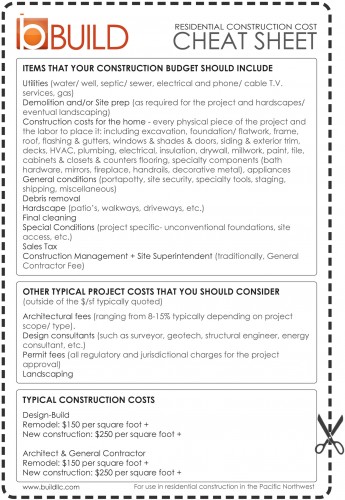

Residential Construction Cost Cheat-Sheet
Here at BUILD, we pride ourselves on being industrious- we establish reasonable project costs very early in the design process with our clients and then stick to those costs till the physical construction is complete. We work diligently to maintain the budget, and when circumstances chosen by our clients or brought to us by the nature of custom construction cause impacts to that budget, we are forthright and manage those circumstances immediately. In our spirit of transparency, we’ve devised the residential construction pricing guide below- around the BUILD community we’ve been calling it the BUILD Cheat Sheet. We believe our industry has done a fantastic job of misquoting and/ or poorly enumerating what the actual construction AND overall project costs of a project are going to be. Many of us have experienced something like… “oh I didn’t know that wasn’t included in the construction costs before” or the dreaded “I read in a (fill in the blank) article that they built the (fill in the blank) for $110/ sf.” What is in that number? Who’s uncle was the electrician? Were the appliances and lighting free? Does it include the cost of the cabinets and finishes? Was it built with student or prison labor? Who verified the number anyway? So, in response to these and other pressing questions, we’re giving the guide away below for free. We hope its valuable as you’re looking at your options for the design and construction of your dream house. And if you want more of the straight scoop, feel free to contact your friends here at BUILD LLC.

The PDF download can be found here.
22 Comments
Other Links to this Post
RSS feed for comments on this post. TrackBack URI


By Knudsen, February 9, 2009 @ 12:28 am
This is excellent. There is so much insubstantial and conflicting information about construction pricing on the internet that this document may actually become the datum. Nice job guys!
By mlm, February 9, 2009 @ 6:52 am
if this sheet is correct, then a new construction 2000 sg ft home would cost about $500,000.00? so basically anyone in the middle class would never afford a new home?? man, that sucks!
By TDI, February 9, 2009 @ 9:21 am
mlm – you must not be from the Seattle area – a half million dollar mortgage here is quite ordinary. As of recently (before the recession) 2 bedroom condos were selling for $500k.
By mobius, February 9, 2009 @ 10:54 am
We’re also talking about custom modern design here, in which case this pricing is reasonable. For people not interested in design or quality there are other options.
By Richter, February 9, 2009 @ 12:36 pm
These cost per square foot numbers may still have sticker shock for some folks, depending on where they live and what they’re used to. But I think the point is being missed here. This “cheat sheet” isn’t proposing the lowest cost – its proposing a method for determining the ACTUAL cost.
By buildllc, February 9, 2009 @ 1:11 pm
There’s some good points being raised here. It’s entirely possible to build a custom, modern home for less than the cost per square foot prices we mention. But if you’re getting overly optimistic numbers in the design stage it’s a good idea to compare the pricing breakdown with the applicable categories in the Cheat Sheet. This document is primarily about keeping the profession of architecture accountable.
By mike, February 10, 2009 @ 2:01 am
working on a public projects lately has given me a much better insight to the realities of construction costs. it’s also been sobering to see these costs normalize a little to numbers in other parts of the country.
do you guys use consultants (ecotech, etc) for energy calcs or do you tend to do them in house?
By buildllc, February 10, 2009 @ 9:33 am
Mike – we’re using a consultant for energy calcs more and more, especially as the energy code becomes more nebulous and out of sync with the manufacturing industry.
By mike, February 10, 2009 @ 9:38 am
whoops, i meant ecotope. how do you guys justify consultant spending as the economy tightens down? we get more and more calls from consultants looking for work or tipping us to RFIs, and at times it seems like we’re looking for ways to trim the fat just in case.
By buildllc, February 10, 2009 @ 10:55 am
Mike – Energy consultants seem to pay for themselves on our projects and I think clients are realizing this. If we were to use a prescriptive energy approach on a residential project we would end up having to use triple-pane glazing because of the walls of glass prominent in many of our designs. A good energy consultant knows the intricacies and exceptions of the energy code and can prove that the numbers work for double glazing. Also in some cases the consultant can prove that a more cost-effective window package meets the energy code. And this is all for a reasonable fee – far less than if I were to try and navigate through the energy code at my hourly rate.
By winston, February 12, 2009 @ 4:28 am
This is helpful, but is design-build really the same price as traditional Architect + Contractor? I thought the whole point of Design/Build was to streamline communication, drawing requirements, etc.
Discouraging…
By buildllc, February 12, 2009 @ 3:18 pm
Winston- that is an excellent question. We have listed the cost per square foot as a baseline (a starting point) with a carefully placed “+” after it. In our experience, we have seen, and BUILD has completed, projects for these lower cost price points. We would love to hear from the traditional design + GC folks reading this blog if these are their baseline numbers, or if they are higher or lower.
Now, in our experience, design build is substantially less expensive than traditional design + GC. We have found projects can save 15% and up by using a design build entity. Many in our industry may bemoan the loss of protection for a client or the watered down nature of the design or the loss of quality on the construction. Basically, we entirely disagree with any of these stances in our practice, and we would offer our portfolio of work that the client can save time, money and headaches by carefully choosing a design (Architect) build one stop shop. Thanks for the question.
By Samuel, February 13, 2009 @ 9:43 am
I’m just catching up on my reading of the blog- I still can’t believe someone has made this information so clear and available. In our limited experience on small remodels, it seems like the builder always wants to shroud the costs in mystery- very antiquated approach. This type of cheat sheet is a great and open response to that outmoded approach. Thanks!
By shola, September 13, 2009 @ 6:42 am
As a designer, i was quite thrilled to stumble onto this website. Keep up the great work. I hope to someday get to a point where i can run a small design/build firm based on your model. great job and an incredible forum. You do a good job of breaking down some of the mysteries surrounding the profession.Thanks
By chad, October 31, 2009 @ 3:20 pm
Excellent to see an architecture firm that not only understands all costs of residential construction, but also takes the time to educate their clients on the details. This is rare in a modern architecture firm. Keep it up.
By Mark Gerwing, December 21, 2009 @ 7:52 am
This is great. I do a similar thing and often feel like I am the sole voice in the wilderness of transparency. Permit costs here can be so much that not being clear about it in the first place can be disaster down the road.
Thanks
By P.S. Eddy, February 1, 2010 @ 9:06 am
Great blog and an interesting conversation. As a G.C. in Denver we deal with budget and pricing issues daily. We have an “open book” policy with our budgets so clients get engaged and can move money around within the budget as needed. The problem I see with the “cheat-sheet” is that for us, every project is different. We’ve built new homes as low as $150/s.f., and we’ve built additions for as much as $350/s.f. We are all for realistic pricing early in the design process, unfortunately that doesn’t always come from the architect.
By Bob Swinburne, March 5, 2010 @ 12:14 pm
I have been enjoying your web presence and will link to your site as soon as I get my act together. cost are very very relative and related to where you live. I only occasionally exceed $200/s.f. in Vermont. But drive two hours to Boston or 4 to NYC and it is a whole different ball game. I try to get a builder in on the ground floor to keep me honest (and back me up with pricing) rather than do a lot of work then go to bid.
By Larry Marchand, April 6, 2010 @ 7:39 am
Thanks for your blog – lots of interesting subjects. Please feel free to make the articles longer! I’m glad I found your website.
I’ve tried to look at your construction cheat sheet and have been unable to at both my home computer and at the office – for some reason the image of the cheat sheet doesn’t come up. I wonder what’s up with that – and could you send it to me?
The context is, I’m a building construction tech, and 25 year construction practitioner, having worked in verious parts of the industry, including residential, commercial and industrial – design, project management and construction. I moved my family from Calgary to Revelstoke, BC about 7 years ago, and have realized the only way I can compete against all the DIY and pick-up conntractors, is to go design-build.
I’d like to see how you organize your budgets, to compare against how I’ve been doing it. I realize there will be regional cost differences, so I’m interested in the percentage values of the categories.
Thanks again for all of your insights. I will be back!
By Rob, May 8, 2010 @ 1:06 pm
patios, not patio’s [sic]
Plurals do not use an apostrophe.
By [zane], June 7, 2010 @ 2:15 am
Sooo…if you’re going for modern but low(est) potential cost. What roof do you suggest? Gable, Shed, Flat? Why? Cheers!
By Build LLC, June 7, 2010 @ 5:58 am
@ Zane – it always depends on the situation and program (and we don’t know anything about yours) but typically we’d suggest a shed roof because of the simple framing and straight-forward roofing.