

Guide to Copper Weathering
Although generally familiar with the stages of weathered copper, we didn’t actually know the data behind the process. Our architecture professors probably attempted to get this information in our heads at some point, but that was prior to the copper renaissance we’re seeing in modern architecture… and let’s face it – in school copper usually meant old Danish church steeples. Having a new found curiosity about the weathering of copper we set out to re-educate ourselves. Most important to us was the timeline in which copper turns from bright metallic pink to darker browns to the greenish turquoise. We were aware that copper weathers differently in various climates, but again, we simply didn’t know the technicalities. So we scoured the web, tracked down some data from a handful of great technical sites and have combined some useful information and color swatches into a quick reference guide. We’ve also rounded up a few modern projects from the Pacific Northwest which are good examples of each stage.

Salmon pink copper: New panels on a house under construction in Seattle’s Magnolia neighborhood
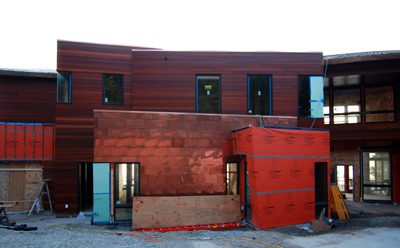
Russet brown copper: Douglas-Truth Library in Seattle by Schacht Aslani Architects

[photo courtesy of Schacht Aslani Architects]
Chocolate brown copper:de Young Museum in San Francisco by Herzog & De Meuron
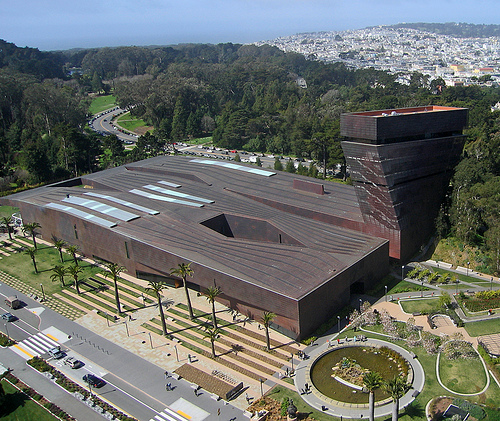
[photo Michael Layefsky on Flickr]
Light green copper:Marine Sciences Building on the UW campus in Seattle by Alan Liddle Architect

[photo by BUILD llc]
A great guide to copper weathering, projects, technical information and detailing can be found here.
Portfolios of award winning copper projects can be found here and here.


By Jim, October 30, 2008 @ 2:45 pm
I attended a lecture by Marlon Blackwell while in school, where he explained that he used copper (the chocolate type) on a building in Arkansas and expected it not to patina to a green color. Something about the air in Arkansas doesn’t affect the material. At the time I didn’t believe him but I have no proof otherwise.
marlonblackwell.com
“Blessings Golf Course” project.
By duph, October 30, 2008 @ 1:54 pm
That’s amazing. I have always wondered how long it actually takes for copper to change colors. Are there any ways to remove the light green surface once it has weathered?
By buildllc, October 30, 2008 @ 4:18 pm
Jim – I’ve heard stories like that as well. They always have that urban myth feel to them, but I don’t have any proof either.
By mike, October 30, 2008 @ 10:53 pm
in dry regions it takes a really long time for the patina to set in, and in many cases it doesn’t due to lack of moisture
vertically oriented copper weathers slower than horizontal, which weathers slower than sloped. i think that’s why the marlon blackwell won’t weather as quickly.
it can also be clear coated to preserve the salmon/russet/etc color.
one of my favorite copper projects is the type/variant house by vincent james
http://coenpartners.com/work/residential/type-variant-house/
there is a really great book on this project for $5, used, on amazon…
http://www.amazon.com/Single-Building-Variant-Process-Architectural/dp/1564965236
einar jarmund (UW alum) recently finished a really interesting copper project in Norway
http://www.archdaily.com/3506/svalbard-science-centre-jva/
laajasalo kirk, Kari Järvinen and Merja Nieminen
http://arquitecturafotos.blogspot.com/2008/06/laajasalo-church-finland-kari-jrvinen.html
ohel jakob synagogue, wandel-hoefer + lorch
http://upload.wikimedia.org/wikipedia/commons/f/f7/München_016.jpg
the layered screen creates a wonderful effect when the sun is shining through
By buildllc, October 31, 2008 @ 12:48 pm
Mike – that variant house by Vincent James is one hot piece of architecture. I’ve got the book on the way, thanks for the skinny. It’s funny that Svalbard, of all places, is on the architectural map with the seed bank and now the Science Center project. Nice.
By mike, November 1, 2008 @ 6:25 pm
werd.
the type/variant book is one of my faves, a lot of quality pics, some details, sketches, plans and put togethor well. it should be the standard of all arch books, actually.
svalbard is in the middle of nowhere! i can’t imagine having weekly construction meetings there… the doomsday seed bank is really depressing – that we need to set up something like this for the “what if” scenario. the need will only become more obvious w/ genetically engineered and terminator seeds.