

Urban Blight

We don’t want to make a habit of blogging about adverse architectures in the northwest but the current “townhouse” model here in Seattle is too appalling to keep quiet about. Sprouting up like weeds, the archetype is identified by their auto-courts, separated 3 story structures, bay windows, intersecting pitched roofs, and unusably small decks –all wrapped up in a nostalgic faux-craftsman envelope. In our current buyers market the white picket fence can easily be negotiated into the deal.

This solution to urban density in Seattle has not only become a stagnant model, but it has spread like an urban cancer in the Seattle metro area. Trying to get our heads around the issue, our R&D team took a driving tour to get a better understanding of these crapsman townhouse hobby-kits. We traveled from the U-district to Shilshole and it was shocking how frequently these models populate urban areas like Wallingford, Phinney Ridge, and Ballard.

There has been a lot of finger pointing about the issue. The City of Seattle Department of Planning and Development is often condemned for creating codes which encourage the model. The obvious target is, of course, the developers of these projects who appear to have shed any ethics about urban planning, healthy design and forward thinking. There is also criticism toward the type of homeowner who would financially support such housing. Each avenue is valid to a certain degree but the more we contemplate the issues at hand, the more it seems to be the responsibility of… us, the Architects. At some point in the process an educated, professionally trained, and licensed architect put their stamp on each and every project and turned it in to the City of Seattle.

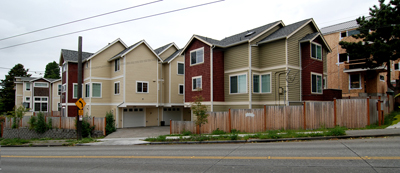
Obtaining an architectural degree from an accredited school requires a minimum 5 years of undergraduate work. There is a professional board which monitors and accredits architecture programs (NAAB) and a professional organization which administers the professional examination for professional licensure (NCARB). Given the rigor of architecture curriculums and the authority of professional review boards, how is it that we are producing professional architects incapable of designing for the current conditions and time?

Above and beyond keeping the heat in and the water out, we Architects have a responsibility to the institutions that trained us and to society at large for the continued evolution of built-form. As the guardians of the architecture on any given project, it is the Architect’s role to protect the architecture against conflicting motives. This is not to say that the architecture can or should always be dominant –a good project is a balance of many elements, but the architecture should be represented. The Seattle townhouse model, however, shows that all architectural agenda has been forfeited.

Our bet is that these architects know better – that profit, indolence or pleasing the developers got the best of them.

The Seattle Times had a good article on the subject from March 4th, read about it here.

20 Comments

  • By christie, July 28, 2008 @ 11:08 am

    What a wonderful post – I too detest these faux craftsmen structures that have been built on the cheap. They truly are ruining neighborhoods all over Seattle and I cannot help but wonder how they continue to get approved. Never mind that they were most likely not built to last and will just be torn down in coming decades – though when that time comes hopefully it will be with something sustainable and visually pleasing.
    Sorry for the novel!

  • By mike, July 28, 2008 @ 10:57 am

    duplex duplex duplex!

    what about the brick courtyard housing @ 49th & fremont as a model?

  • By Miguel, July 28, 2008 @ 12:25 pm

    We have them all over Portland too. It is getting to be a little silly and absurd. They’re going to be this generations dingbat apartments.

  • By buildllc, July 28, 2008 @ 2:16 pm

    Mike – I zipped up to that 49th & Fremont project at lunch – very impressive. It’s traditional but authentic and a bit bigger than the projects mentioned in the post but a great example for larger scale work. Even the facade of repetitive garage doors on the east is more intimate and sidewalk friendly than the main facades of most of the work mentioned above. And the courtyard is gorgeous. Glad to have this one on our radar.

  • By babs, July 28, 2008 @ 3:01 pm

    You have it right. Those ruin the neighborhood and just make it ugly.

  • By mike, July 28, 2008 @ 3:45 pm

    i grew up overseas, and we lived in a similar community for a few years, it was a really enjoyable experience. it’s like a condensed cul-de-sac. if you guys are interested, i’ll send a few multi family projects i really like (on the smaller scale) for a future (follow up) thread

  • By buildllc, July 28, 2008 @ 11:37 pm

    Mike – send the images our way, a post on sensible urban housing sounds like a good idea.

  • By Les Fitzpatrick, July 29, 2008 @ 8:24 am

    The real blight on our neighborhoods isn’t today but rather in the too near future when these questionable abodes begin to prematurely show their wear and tear.

  • By Carol Harlow, July 29, 2008 @ 9:12 am

    Your pictures tell the sad story very eloquently. And, if this is “gentrification” one has to ask where is the improvement?

  • By Charles, July 29, 2008 @ 5:24 pm

    Oh yeah, these are all over Portland right now. Tear down one house, build this crap in it’s place. The asking prices are equally absurd. Like it was said before, the are as poorly crafted as they are designed. They’ll do it all over again in 30 years. But we’ll have to look at them in the meantime.

  • By Juliet, July 31, 2008 @ 4:21 pm

    Oh, ouch… My husband and I bought ours in 1999. We have watched over the last eight years how this typology has been evolved by the rising price of real estate, market driven demands of buyers, and a stupid building code (why require 1:1 off-street parking at all?). Luckily, our builder wasn’t driven to provide garages to meet the off-street parking–we have alley-accessed assigned surface parking and decent sized “yards”. I agree that they are vanilla, but for a first home inside Seattle I’d say we were very, very lucky. Our other choice might have been to buy in (gasp) Lynnwood. If there was an IKEA version (stylish and affordable) of a townhouse we would have bought it.

  • By buildllc, July 31, 2008 @ 4:47 pm

    Juliet – that’s a good point. There are so few options for downtown living. The architectural diversity simply doesn’t exist in Seattle.

  • By chad, July 31, 2008 @ 5:10 pm

    This stuff almost looks nice compared to the crap that hack builders throw up in my home of Philly, PA. The 6th largest city in the US and the birthplace of so many great things in our history just can’t seem to get the whole urban planning thing down. It’s sad.

    Here, there are ten lousy architects that will pump our junk on the cheap for every good architect struggling to make a living due to the low standards in fees created by the former firms. Again…Sad.

  • By mike, July 31, 2008 @ 10:17 pm

    yeah, but philly deserves it after what bacon did to kahn!

  • By Matt, August 6, 2008 @ 7:35 pm

    Great post and comments! Though the discussion might have been more timely 5-years ago. I’d love to see a follow-up that showcases better examples of similar townhouses / rowhouses / duplexes: Fremont & 49th, PB Elemental, et al. I’m optimistic that good developers / architects will continue to raise standards for this type of product… 10-years ago Belltown was filling up with beige styrofoam boxes like Fountain Court and Belltown Court… now new construction there is steel, concrete and glass. Lets hope these things evolve too…

  • By andrew, August 6, 2008 @ 11:59 pm

    Matt – a blog post of positive examples is in the works, stay tuned.

Other Links to this Post

  1. The Creature Speaks » Blog Archive » Urban Blight — July 28, 2008 @ 2:40 pm

  2. Elsewhere « Visualingual — August 1, 2008 @ 5:11 am

  3. Models for Low-Rise Multi-Family Housing: Europe « BUILD Blog — October 17, 2008 @ 1:48 pm

  4. Models for Low-Rise Multi-Family Housing: U.S. « BUILD Blog — October 21, 2008 @ 11:54 pm

RSS feed for comments on this post. TrackBack URI

Leave a comment