
Board & Batten Siding

Board and batten siding is the underdog of siding systems, but we like it for the following reasons:
It has the potential to be visually clean and crisp
It has a timeless look and weathers nicely if implemented correctly
The system takes the natural expansion and contraction of materials into consideration
It’s been around for a long time, carpenters and siders are familiar with it
It’s durable

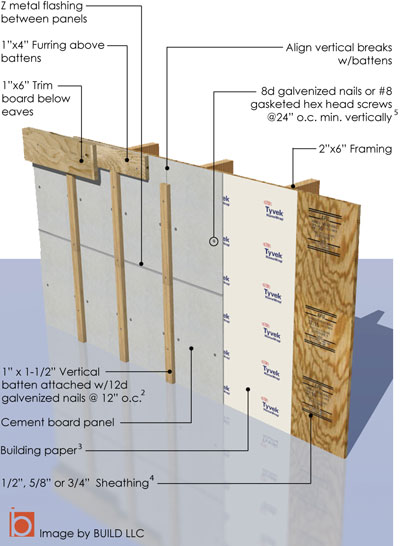
So why isn’t board and batten siding more prominent in modern architecture? A quick Google-image search suggests that most board & batten siding systems are associated with traditional architectures – country cottages and old leaning barns. The word “rustic” comes up often when researching board and batten systems. But technically the system has everything necessary to be a serious, modern strategy for siding. So the BUILD research and development team has put together a guide to board and batten siding systems. These diagrams are just departure points – coordinate with your structural engineer for unusual situations and the use of panel products.
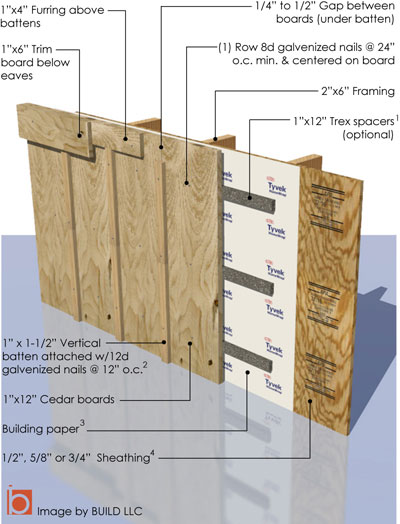
1. Horizontal spacers can be placed behind the board & battens for better air circulation, the spacers also provide a uniform nailer backing to the system.
2. The fasteners and pattern will depend on the size of the batten.
3. A variety of products can be used in lieu of building paper including VaproShield products.
4. 1/2″ sheathing can be used if blocking is installed behind at fastener locations. We recommend just bumping up the sheathing to 3/4″.
5. The fastener pattern for panels depends entirely on the panel product used and the overall geometry.

With wood boards the fasteners should be centered on the board so that the board can expand and contract in both directions. Using fasteners at the edges will cause the boards to crack over time.
We’ve also tracked down several modern applications. Let us know of any sharp B&B applications you know of out there.

Dogtrot House in Poplarville, MS by Waggonner & Ball Architects

[photo by Kerri McCaffety, Mac Ball, Catherine Smith]

Donald Barbour House in Kentfield, CA by John Marsh Davis
The batten geometry integrates with the structural columns… nice.

[photo by Alan Weintraub]

House for an art collector in Therwill Switzerland by Herzog & de Meuron, 1986
Precast concrete panels and pine slats

[photo by Hisao Suzuki]

Wood Residence on Vashon Island, WA by James Cutler Architects
Cedar board and battens

Irby House at Sea Ranch, CA by Obie G. Bowman, 2001
Redwood board and battens

[photo by Tom Rider]

Girvin Cabin on Decatur Island, WA by Miller Hull


[photo from Miller Hull Architects of the Pacific Northwest by Sheri Olson]

City Hall on Bainbridge Island, WA by Miller Hull, 2000


[photo from Miller Hull Architects of the Pacific Northwest by Sheri Olson]

Nickerson House in Seattle, WA
Painted Hardi-board and wood battens, anybody know the architect of this one?

[photo by BUILD llc]

Shack at hinkle farm by Jeffery S. Broadhurst
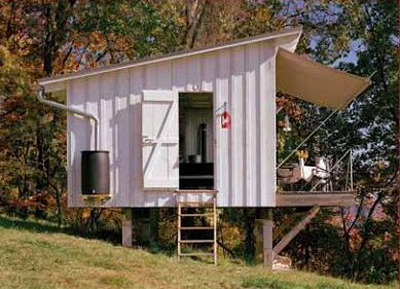
[via materialicio.us]

“Barn Doors Open” in Falmouth, Maine by Kaplan Thompson Architects
The added volume uses a reverse board & batten system.

21 Comments

  • By mike, July 8, 2008 @ 10:46 pm

    the House for an art collector was worked on by annette gigon (of gigon_guyer) who has gone on to do a number of sick rainscreens, but alas, no board and batten.

    breuer did some board and batten, or was that formwork for concrete, i can’t recall…

  • By JS, July 9, 2008 @ 8:33 am

    Where can I find more info and pictures of the Donald Barbour House?

    Altho not traditonal B&B, FLW’s Usonians have walls that are B&B.

  • By Anonymous, July 9, 2008 @ 8:39 am

    JS – there is a great book out titled “Forgotten Modern, California Houses 1940-1970″ by Alan Hess. The Barbour House is featured on pages 212-219.

  • By mike, July 17, 2008 @ 1:24 pm

    ray & mary johnston’s fremont lofts have a fairly nice board and batten as well…

    http://www.johnstonarchitects.com/images/work/fremont_lofts_03.jpg

  • By ek, August 6, 2008 @ 11:24 pm

    What are the pros and cons of cement board vs. wood vertical battens? For a DIYer, products like Hardi-Board seem problematic, but might last longer with lower maintenance. What reclaimed wood materials can be used as battens? Is there a cheap but effective, and more energy efficient method of achieving the aesthetic?

  • By buildllc, August 18, 2008 @ 9:56 am

    ek – we don’t recommend using cement board as the battens (only the boards). The best solution for the boards is probably 12” wide cedar planks in either the 1” or 5/4” thickness. The tighter the grain the longer the boards will last, 1st growth cedar will have the tightest grain. Any cedar boards in these dimensions are expensive though – while cement boards may not have the same life-span, they are a more cost effective material out of the gate. We still recommend using cedar battens even with the cement type boards. As far as reclaimed woods for the battens go – you still want to stick with woods that are resistant to rot (cedar, teak, Ipe, Bangkirai). If you are painting the siding system anyway, Trex would make an excellent batten. A similar look can also be achieved by using standing seam metal roofing as the siding – it comes in a variety of dimensions and can have up to a 50 year warranty (on roofs, not sure about siding). A standing seam metal siding system would be the most enduring system of anything mentioned.

  • By stevel, September 19, 2008 @ 7:37 am

    source for cedar siding

  • By Paul, July 2, 2009 @ 6:06 am

    How about detailing a horizontal board and batten design? I think those are much more attractive.

  • By Denise Thornton, July 7, 2010 @ 1:43 am

    I love the great photos you found to illustrate board and batten. We are putting battens on our timber frame barn and really loving it.

    I linked to your site when I posted about the process today.

    Check it out at http://digginginthedriftless.wordpress.com/2010/07/06/board-and-batten-on-our-barn/

    Denise

  • By Juan, May 19, 2011 @ 10:06 pm

    Thanks for the post, it is very useful. Right now we are trying to find out why a client used board and batten exterior covering using 8mm (!) Bangkirai boards in a former project. Detailing issues are causing lots of problems…
    Cheers!

  • By Build LLC, May 20, 2011 @ 7:06 am

    @Juan -yeah, we’ve found Bangkirai to be problematic. It shrinks much more than it’s rival Ipe (or ironwood). Also tough to work.

  • By Joe, June 17, 2011 @ 6:43 pm

    I agree that the horizontal bnb is more attractive. E.g. Google images of flw’s pope-leighy house and the cypress bnb. Clearly the horz siding doesn’t shed water as well. Oh well, that’s the cost of style.

  • By Eric, August 14, 2011 @ 9:24 am

    I see that this is more a traditional siding style, or I mean with the optional trex spacers it is more of a closed rainscreen. With boards running vertically like listed above or in your Bainbridge Island project the spacers (if they have any) are horizontal. Is there a detail used to promote airflow from the base of the wall to the soffit or top of wall vent?

  • By Build LLC, August 16, 2011 @ 9:00 am

    @Eric -the horizontal “sleepers” are less about airflow and more about providing an even surface to mount the siding to. They act like shims in a way.

  • By mike eliason, August 17, 2011 @ 8:30 am

    @eric,

    the detail to promote airflow in an actual rainscreen assembly would be vertical battens fixed to sheathing, counter (horizontal)battens outside of that. then the board and batten affixed to the counter battens. pretty rare here, but that’s a common detail in europe. for roofs as well.
    http://www.fragdenarchitekt.de/content/binary/Brettersto%C3%9F%20Deckelschalung%20Blech.jpg

  • By ron metheny, December 9, 2011 @ 9:45 am

    Kevin,
    I came across your 2008 article on B&B today. If you have the time to answer I would like to ask
    you a few questions.

    I bought this property in 2009. This cabin was 4mi from the 8.8 Chilean earthquake in 2010. No damage.

    I am removing the “very rustic” siding on my little house. Mostly, to repaper it correctly w/ 15lb felt. As you see in photo 2, the framing uses 4×4 for everything. This is typical in Chile as 4×4 and 3×3 are cheap.
    I want to use 4×8 cement board over the 15lb felt over 11mm OSB. I will nail 2×4 backing in between the framing where necessary to stiffen the OSB.

    So, my questions are:

    1. What is the min thickness for the cement board I could use. My choices are 4mm, 5mm 6mm & 8mm . I would like to use 5mm or 6mm max, if possible. The cost is $16 & $20 per sheet. Also, the weight per sheet will be an issue for me to install.
    I have always thought that the siding on a house was mostly to protect the felt or wrap, properly installed and flashed, from the UV degradation.

    2. As you may have noticed, my rafters are 5″ rough pine poles. Somewhat difficult to trim around. What is the purpose of the 1×6 trim over 1×4 furring strip in your drawing? Looks?
    I have not decided how I will trim out around the rafters. How would you do it? It needs to be trimmed tight to help stop the winter winds from coming in the interior as it does now! The eves overhang 14″.

    Thanks for your time.

    Sincerely,
    ron metheny

  • By Kevin E, December 14, 2011 @ 8:07 am

    Hi Ron,

    I can’t really speak to the minimum thickness of the cement board, but here, we use 1/4″(6mm) material. This seems adequate for our environment.
    As for the 1×6, it is a trim piece used at the eave- we’d view this as an alternative and not a requirement.
    Best- Kevin

Other Links to this Post

  1. Uppsala: Two Important Buildings « BUILD Blog — August 21, 2008 @ 7:48 pm

  2. Finnish Wood Detailing « BUILD Blog — September 1, 2008 @ 4:02 pm

  3. Board and Batten Siding « Living Well in Westchester — January 19, 2009 @ 7:24 pm

  4. Board and Batten on Our Barn « Digging in the Driftless — July 6, 2010 @ 5:28 am

Leave a comment