

Despite the growing popularity of rainscreen systems, we find that most people don’t know much about them and don’t understand why they are important to architecture. Like most innovative building systems it was the Europeans that first introduced the concept. One of the first examples we remember seeing is the IRCAM music school completed in Paris in the late 70’s by Renzo Piano. In the last decade we’ve noticed a growing interest and use of raincreens on buildings and houses here in the northwest. The concept of a rainscreen is to create an air gap between the siding material and the water-proof surface. This allows the structure to breathe a bit. Current building codes require structures to be sealed up so tightly that it’s causing unforeseen problems. More traditional siding systems often trap moisture between the various layers of materials. Differences in air pressure between the outside and inside of a building can actually drive air and, more dangerously, water into the building. The rainscreen system uses a water proof membrane to keep the water out, but it allows a bit of air movement – it’s like a Gore-tex wrap for your building or house. This membrane is a softer, more delicate material, it’s also sensitive to sunlight; UV rays will eventually break down the product if directly exposed. This is where the siding comes in. The siding, or skin of the building, is required for protection from physical harm like soccer balls and also to shield the membrane from sunlight. There is typically an air gap between the skin and the membrane of approximately one inch. If detailed and constructed correctly the system allows the building to breathe, allows the inside and outside air pressure to balance better and allows a tremendous variety of materials to be used as the skin. It is a more expensive system and requires more time and care for the installation but a well made rainscreen is hot, modern and functional.

1. Panel: Panel thicknesses vary; we’ve found most of them to be 5/16” thick. Panel sizes are typically 4’ x 8’ and 4’ x 10’. Products that we’ve had success with so far are Cembonit by CBF, Hardie-Panel, Swiss Pearl, Fincolorply, and Cor-ten steel.
2. Fastener: Typically we use a #8 wood screw with a gasketed hex head. Some panel types require specific fasteners. It’s also possible to flush mount flat head screws if the panels are properly pre-drilled, and if you have a lot of free-time. The fastener geometry is typically 12 to 24 inches on center in each direction. It’s very important to line the fasteners up on a grid as the fastener pattern becomes part of the finished look of the rainscreen system.
3. Vertical Runners: Trex is a great product for this application because it doesn’t move axially and it doesn’t rot. The dimensions of the runners entirely depend on the specifications required of the panel product – we tend to use 3/4” x 3/4” strips more often than anything else. Cedar or pressure treated lumber can also be used, be cautious of the expansion and contraction of these products.
4. Air Space: The dimension of air space typically ranges between ¾” to 1-1/2” depending on the panel product specifications
5. Membrane: This membrane is basically like Gore-tex for your house – it keeps the water out but lets air through (it lets your house breathe). There are many different brands, we like VaproShield because of the products function, durability and that they just started making it in black so that the membrane disappears in the shadows.
6. Flashing: The flashing we use at window wraps (like the one above) is typically a peel & stick application. It is flexible to deal with all sorts of different situations and angles.
7. Sheathing: You can either use ½” plywood and install flat blocking at all of the panel joints or use ¾” plywood behind all panels – we recommend the ¾” as it is MUCH less work. In either case you’ll want to use CDX plywood – don’t use that OSB crap here.
8. Framing: Typically 2×6 framing at exterior walls but this could vary depending on the situation.
9. Reveal: Typically ¼” but this varies with the panel product and desired finish look.
Okay, let’s get to some examples around the Seattle area:
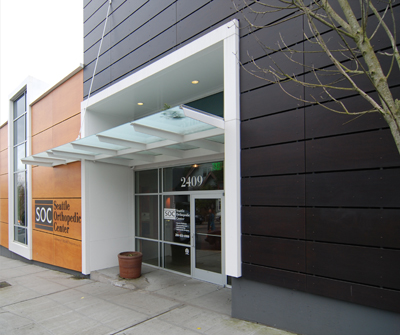
Seattle Orthopedic Center at 2409 N 45th St
The project seems to use the Fincolorply system, or something very close to it. A very well crafted building that we recommend checking out. It displays two-different panel types.
Architect: Collins Woerman

[Photos by BUILD llc]
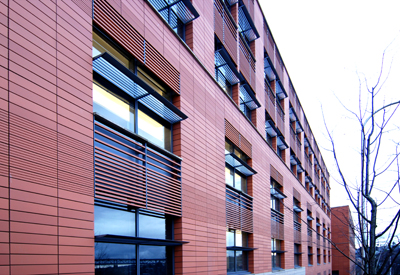
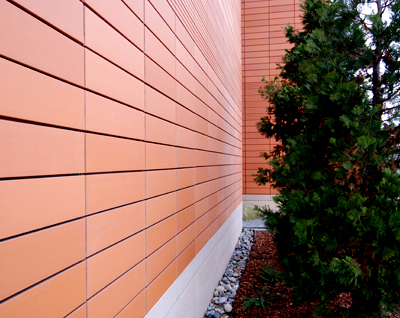
The William H. Foege Building at NE Pacific Str & 15th Ave NE
The panels seem to be a fired clay, almost brick-like in look and texture. The building is a very impressive display of the rainscreen system
Architect: Anshen + Allen

[Photos by BUILD llc]
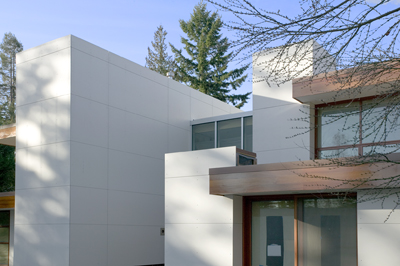
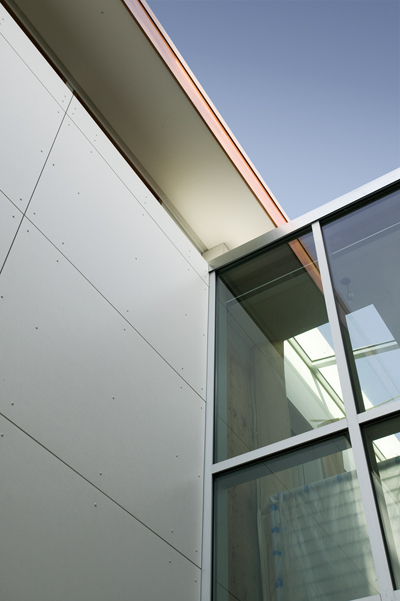
Medina Residence near Seattle
The residence uses the Swiss Pearl system and is designed with the precision of a cabinet at the exterior. The panel system continues inside to certain areas of the interior.
Architect: BUILD llc

[Photos by Swiss Pearl]
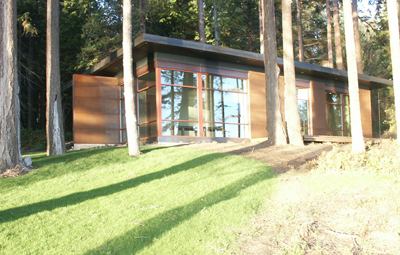
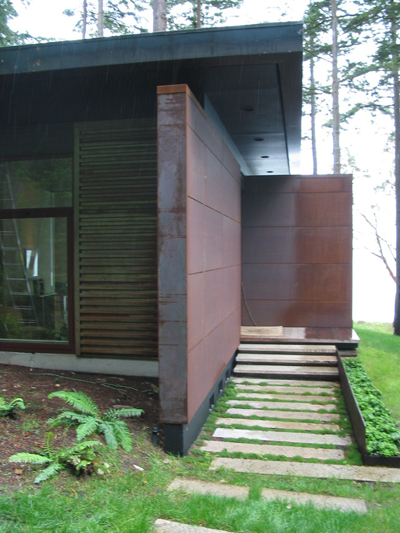
Camano Cabin on Camano Island
The residence uses steel cor-ten panels as its rainscreen. The panels develop a layer of rust which continues to weather over time but protects the inner layers of the panel.
Architect: BUILD llc

[Photos by BUILD llc]
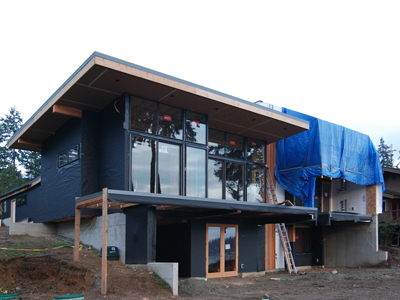
Dr. Marc Ferrin Residence on Bainbridge Island
The residence has just been wrapped with the membrane and will soon be receiving a skin of Cembonit rainscreen.
Architect: BUILD llc

[Photos by BUILD llc]
It’s taken us several years and many jobs to gather the resources and knowledge about these rainscreen systems. So why do we take the time & effort to post this info online for anyone to use and distribute for free? Because the battle against ugly, senseless architecture is a tough one and we need all the help we can get. Cheers


@Jin – that was a coat check at the front door – not a sense of humor check.
Nice post. It is great to see a straightforward explanation of a simple rainscreen system. I love the picture/diagram.
I am looking at a project that is calling out a solid phenolic siding panel,I am not familiar with the term and found this site while researching it. can someone explain it to me? is it a paticular product or a term describing a product?
@ John – “Phenolic” is a generic term for a plastic composite panel. These panels are manufactured by a variety of companies and have many different finished looks – for instance we just used phenolic panels on a project that have a wood grain veneer on the finished face.
excellent post. i’m an arch grad student researching rain screen systems & this has been an enormous help. many thanks! added the site to my feedreader
Great, informative site. As a builder relatively new to the the modern design world, I must say I’m thrilled with the performance of a two year old cebonite rain screen home we built here in Salt Lake City. Lots of snow/moisture in winter, then desert dry heat all summer. Zero movement, zero aging, no bugs, very good thermal performance. Blew away our experiences with Hardi-panels.
@ Rob -indeed the Cembonite product is much more durable than the Hardi products. Glad to hear that the Cembonite does so well in temperature extremes – we don’t get to test those variables so much in the temperate Pacific Northwest.
I am building a shop using a combination of corrugated metal and a Hardipanel rainscreen. Do I need to fur the metal for venting or can I fasten it directly to the plywood.
@ Kevin – you can attach the metal directly to the plywood and weather barrier if you’re overlapping the metal panels in such a way that moisture doesn’t get behind the panels. You’ll also want to make sure and attach the steel to allow for expansion and contraction.
Collins Woerman medical building is covered with PRODEMA panels over rain screen system available from SPEC SYSTEMS in Kenmore, WA. Talk to Wade Nash.
This is very helpful, and timely, information – our architect is encouraging us to replace our current siding with a rainscreen. We can’t decide on whether to go with the open screen, or a closed screen (with flashing between panels). Bugs and spiders were one of two big questions for us, and I am glad to see that they don’t seem to be a problem. The other problem we have is woodpeckers. We live near Carkeek Park in Seattle (very wooded) and we have both Pileated woodpeckers and Flickers, that we occasionally see working on the houses in our neighborhood. Any experience with this? Also, can you recommend an ‘envelope’ specialist, in Seattle, who might oversee the rainscreen installation process?
@ Steve -we haven’t had any issues with woodpeckers. As far as envelope specialists go, we’ve used Wetherholt and Associates Inc. out of Kirkland in the past and we’ve been happy with their work: http://www.wetherholt.com/
I love your site and the work you guys do! I am currently looking into installing an open rain screen system as well and am wondering if you have any experience with hardi-panel siding. I am worried about water getting into the exposed edges and then the panel starts to delaminate. Any advice or insight would be much appreciated.
@Markus -we haven’t used hardi-panel in a rainscreen situation -it doesn’t seem sturdy enough. We recommend an engineered product like Sil-Leed by CBF, Swiss Pearl, Trespa or Parklex.
Dear Build LLC, thank you sooooo much for sharing your wealth of knowledge. Your work very impressive. I am about to go into CD for a small modern house here by the water in CT. My client’s budget does not allow me to use Parklex or the other materials, so my choice has been diminished to HardiPanel and Artisan Lap siding. Have you had any experience with the Tamlyn accessory trim details.
Here’s a link to the renderings of the house used to obtain all the variances we need to get.
http://homepage.mac.com/rengarch/filechute/JacksonRender.zip
Thanks again for you sharing your knowledge and expertise.
@Rita -yes, we’ve used some of the Tamlyn accessory trims in the past. We’ve typically found them to be a bit bulky, but they paint out nicely with the panels.
It looks like CBF is no longer supplying Cembonit in North American. One other material we’ve used comes out of Canada – we used on a house on Capitol Hill. Check out rocksiding dot com. Rather than a panel, it’s linear cementitious planks hung on metal runners. Easy on, easy off – and so far no vandalism!
@Tristin -thanks for the tip, we’ll check out the rocksiding. CBF calls their new product “Sil-Leed” -it’s very similar to Cembonite.
Thank you-Thank you for your blog!
I want a smooth non-fastener appearance to my fiber cement panel siding which Id assume using proper nail application & feather out nails with fine cement (like drywall). Here’s an example from Australia which is a look I want//this house shows a seamless metal panel roof to FCP siding smooth transition so im guessing to achieve that the rainscreen has to wrap from roof to walls, basically everything? or the metal roof panels have a u-channel between each panel for no water penetration on roof…
Klien Bottle House (Australia):
http://www.archdaily.com/7952/klein-bottle-house-mcbride-charles-ryan/
If you want to expound more on this house’s irregular
siding shapes please do.
Construction Photos:
http://www.flickr.com/photos/lamidesign/sets/72157606565238082/
I know they used Hardi Villaboard 6mm for the large balcony soffit & taped the seams..I wonder if all that green is the tile adhesive coating they use over there.
Other example of feathered out fasteners:
http://huddartshouse.blogspot.com/2011/05/painting-progress.html
Interesting>This guy used Minerit Lightweight FCP coated with masonry sealer for his shower> Fastened with construction adhesive
to hardi backer for a seamless non-fastner look, caulked seams.
http://livemodern.com/forums/materialsmethods/865609165
I wonder if the Aussie house caulked the seams or used some
aluminum channel..
Thanks alot!!
-Greg
aluminum channel..
Thanks alot!!
-Greg
I live on Vancouver Island, Wet coast of Canada and I had an infestation of carpenter ants attemp to feed on my mobile home. They crawled over the drip edge flashing and up between the corrigations of the metal siding then ate their way through the 5/16 plywood.
When I built my home, I made sure that I had more than a reasonable height between the ground and the siding and I incorperated wide overhangs to provide a dry walkway around the house.
After 25 years the cedar siding is begining to lift and I find the odd carpentry ant trying to investigate access to my home. Best I can say is they must have access to water and they wont find it in my walls!
It is my intention to replace the cedar with hardiplank as we are in a forrestfire risk area.
@Ion -the typical code here in Washington state is to maintain a minimum of 6″ between the ground and wood siding. Meeting this minimum helps keep the bugs and moisture out. Hardiplank should also help fight against water and critters.
Yes the 6″ clearance minimum is a must, however I have never really embraced the ‘new’ concepts that deem that the house should be air tight and then have to build in ways to venilate. That has alway be a contradiction. And early on these house were having problems with mold.Heat loss should not be confused with air tight. Air flow vs drafts. Bugs will find their way into cracks and crevices. Blue bees will plug a 1/4″ hole. Spiders will spin webs inside a space so well that air flow will not be present, hence moisture will be retained and invite other insects such as termites and carpenter ants. Hope I dont sound like a doomsayer, but the housing industry has been selling us a belts and braces attitude costs us money when sensiblity is the economical approach.
I should add that I have never heard of the term ‘rainscreen’ before but am familiar with the air gap required for masonary and houses wrapped in Tyvek or similar. My house, built in the early 80′s has tar paper under the cedar siding and we have not had any mold or dampness issues or insect problems. Have I missed something?
@Ion -we entirely agree about wrapping the house up airtight and then needing to create airflow. Traditional construction techniques quite often allow the house to “breathe” better. Unfortunately the building code enforces a different set of requirements.
Rainscreens tend to balance this out – the structure can meet state and city codes, while the assembly allows some air flow. Rainscreen systems also allow quite a bit of freedom with the siding materials.
As you’ve said – sensibility is the most economical approach. You haven’t missed anything.
Great information and products. I am using a 3/8″ furring strip to give us air space between wall and wester red cedar siding. We were not going to use any space between boards. We could vent at the bottom but would we need to vent at the to? It is a parapet wall with mental cap on top. What is your thought.
Can you provide some figures into how much air can filter through the membrane? for example, if an open space is 100% air flow, how much will the membrane allow? 1%, 5%? 10%?
@ Jorge -not sure, you’ll have to take that one up with VaproShield.
Thank you, I got the data from VaproShield. I was asking because I have a patent pending innovation that consist on a panel that allows air to flow freely (almost) while preventing rain water to penetrate, it definitely has way more air permeability than the membranes. I am looking for potential licensees to take this product to market. It can find applications ranging from residential buildings, to farms, animal shelters, greenhouses, tents, electronic appliaces, etc. Do you have any suggestions on who I could contact? Thanks in advance!
Great Post. I have referred to your web site many times while we build our house.
Two questions. First, do you have a link to the Trex runners? All I seem to find on the internet is trex decking.
Second, the fasteners used to attach the runners (be it trex or other furring) make holes in the membrane. I am puzzled as to how the membrane continues to work as a rain barrier?
I know some membranes are self-sealling, but I don’t believe the Reveal shield is. What I’m I missing?
One of the major problems currently associated with building better houses is the sheer volume of information, and misinformation out there. Too many of the terms currently being used are poorly understood and stories that seem to make perfect sense from a traditional building sense turn out to be simply incorrect. Building envelope technology is moving forward at breakneck speeds and there is a lot to absorb, so it is really no surprise that a lot of questions arise!
First lets make sure we are all talking about the same thing :
RAINSCREEN style construction denotes the practice of including a drainage channel behind the exterior CLADDING but outside the WEATHER RESISTANT BARRIER (WRB) which is ideally a water and air barrier applied to the SHEATHING of the structure.
CLADDING is a durable and attractive exterior layer intended to be esthetically pleasing and protect the WRB from UV and physical damage. While it may or may not shed some percentage of bulk water, most modern envelope designers do not consider siding toprovide any meaningful barrier to air or moisture.
The WRB layer should be designed as the primary moisture resistant envelope. When installed it should protect the SHEATHING if the structureagainst the two main sources of moisture related damage to structures; BULK WATER and MOISTURE LADEN AIR.
BULK WATER reaches the WRB when water flows, leaks or is pushed by windvthrough gaps in the CLADDING. The WRB should provide a waterproof seal that prevents both deterioration if the sheafthing itself and further penetration into the wall assembly itself.
MOISURE LADEN AIR is a much more destructive force than most people realize. The more ENERGY there is in the air, which in this case denotes temperaure, the more water it will hold. When that energy state of that wateris reduced it is forced to release some of the water it has been carrying. If the building envelope is not well sealed against air infiltration,
Literally QUARTS of water can be carried through small holes in the envelope onky to be deposited on the cooler side of the wall as condensation. Ideally then, our WRB would also be an air barrier, or at least resist air infiltration.
RAINSCREEN (or “drain plane” style consruction if you prefer) dictates that a space be provided between the CLADDING and the WRB covered SHEATHING so that water can flow freely behind the CLADDING to the bottom of the wall and escape rather than be held against the structure until it is absorbed where ut can do damage. There seems to be some degree of dispute between “experts” as to the proper amount of open space between the CLADDING and the WRB but enough to make a decent capillary and thermal break seems prudent, so at least 1/8th inch with 1/4″ to 3/8″ seeming a better minimum to me.
The last mode of moisture transport is also important to consider, but nowhere near as important as buyers are currently led to believe. A lot is made of the “breathability” of various materials used in building envelope design but more people misunderstand this concept than any other and as a result misunderstand modern building science efforts to build better structures. When someone asks if a product breathes they are really asking if it is PERMIABLE. PERMIABILITY is atomic level diffusion which means it is a measure of how quickly molecules of water vapor migrate through a material and that speed is VERY SLOWLY. WRBs typically have a PERMIABILITY rating of between 6 and 56. When the PERMIABILITY of a wall asembly as a whole is tested with any permiable WRB whether to the top or bottom of that range, they all test within a few percent of the same. PERMIABILITY measures grains of water moving over days of time so it is really the least of the problems facing a building envelope. Its main job is to allow a very slow drying of the inside of the wall cavity to get rid of moisture built into the wall originally and to add drying caoacity in case obe of the more important protections fail.
I apologize for being so long winded, but I travel around teaching building science to buyers, builders, realtors, and just about anyone who will listenas part of my job. We make some great envelope products that frankly sell themselves when people understand the principles of better building design. If we were to consider energy as well i could go on forever ….
If there are any questions i can answer, dont hesitate to ask. Sorry about the typos – punched this out on a tablet while I am on the road,
@ Rick – it’s pretty dang awesome to have an expert such as yourself adding important and valuable info to the discussion. A HUGE thanks from BUILD.
The Corten rainscreen in the Camano Cabin looks great! What is the gauge of the steel? Is there any concern of oil canning when using a flat panel? Thanks!
We hired an StudioDEC to design a new cladding for our home as it currently has EIFS. He came up with a open joint rainscreen approach using hardi. Looked great on paper until I began doing the research and after discussing with siders and hardi it was found out that james hardi does not recommend open joint rainscreens. And after looking around Seattle I’ve seen several homes/townhomes using the hardi open joint approach and failing. The panels begin to warp and de-laminate. I’m a bit surprised that people would select this as a material choice. With our 50k project budget we couldn’t use silbonit so we’ve opted for a closed rainscreen approach. Is there any reason to use a premium product like Vaproshield once we flash all the joints? or can we switch to Tyvek? Any advice would be greatly appreciated as I’ve lost confidence in our current designer.
@ Dan T -Hardi panels can be used in a rainscreen application but the panels need to be sealed/painted on all sides prior to install. The next most cost-effective option we’ve found is the SIL-LEED panel made by CBF.
It’s difficult to advise without seeing details, but technically a closed siding system that is fully flashed isn’t a rainscreen (it’s a traditionally applied siding system) and therefor shouldn’t require a weather barrier like Vaproshield. If the siding is doing all the work of keeping the elements out (rain, wind, etc) then a building paper like Tyvek should suffice. Again, not being familiar with the project and without having details in front of us, take this advice with a HUGE grain of salt.
I am considering an open joint rain screen incorporating oxidized steel panels. The panels will be 3′ x 8′ in a vertical orientation with furring at edge and midspan. What gauge steel have you had success with? I am in Denver, so itis a dry climate with significant temperature swings. Thanks.
Great info, thank you.
Regarding open rain screen:
I’m curious if you’ve encountered any issues with the fiber cement panels delaminating or separating due to their top edges being exposed to moisture? I’ve been told by Nichiha and Hardie that they don’t recommend the edges being directly exposed. They say it must be flashed or lapped. Have you encountered any issues?
Thanks!
I should also add that I’m waist deep into a remodel design that similar construction tech. so I’m hoping you have had lots of success on your projects.
Hi Guys,
I’m glad u r here giving advice.
I’m planning to use open gap James Hardie siding.
I have Tyvek over OSB sheeting now – can I use tarpaper over the Tyvek for extra protection?
What kind of material and thickness should I use for furring strips?
Also how much gap do you recommend?
Thank you so much
@mark -Tyvek + tar paper is not a system you want to use in conjunction with a rainscreen (while it may keep the rain out, it doesn’t breathe). You want to install a system specifically intended for rainscreen systems like Vaproshield. The size of the vertical runners depend on the water proof membrane you select. We like to use the Wallsheild system by Vaproshield with 3/4″ thick vertical runners.
Thanks SO much for all this info about rainscreens and breathable WRB’s. You’re right, all of this high-performance envelope information has gotten terribly confusing! So I appreciate your clarity. <y question refers to what happens to the WRB when you transition from the frame wall to the CMU/manufactured stone foundation walls for an unvented crawl space? If the WRB moves to inside of the CMU and under the insulation, where does it happen?
@Beyhan -not sure we understand this detail. Why would you move the Weather Resistant Barrier to inside the CMU wall?
Yes, that’s the question. Is there any benefit to moving the vapor barrier inside so that the block and brick can dry to the outside? Or is this nuts?
@ Beyhan – it’s difficult to determine without seeing a detail but typically you want to keep the Weather Resistant Barrier exterior to the insulation.